Category Archives: Visual Art

Pandemic Art Adventures: MIT

The closing of museums during the pandemic put me in a state of art withdrawal.  In search of a fix, I traveled to various locations in the Greater Boston area looking for publicly-accessible art.  College campuses are great place to find art, so one day in June I visited the Massachusetts Institute of Technology (MIT) in Cambridge, MA to see what art I could find without having to go inside.  I found quite a bit of art, which I was able to identify either through plaques or an online search. MIT has an excellent website with additional information here.

K2B Eero Saarinen - MIT Chapel (1956) Cambridge, MA
Although Eero Saarinen’s 1956 MIT Chapel is a work of architecture, it’s compact size and modernist belltower make it feel like a sculpture, so I am including it here.  Other interesting works of architecture on campus are Baker House (1948), one of only two permanent structures in the US designed by Finnish architect Alvar Aalto (see below),
baker house 3
and of course, the whimsical Stata Center (2004), by Frank Gehry.
stata center 1
stata center 5

L8B Alexander Calder - La Grande Voile (The Big Sail) (1965) (1) MIT
Alexander Calder’s La Grande Voile (The Big Sail) (1965), made of painted steel, is located in McDermott Court.
L8C Alexander Calder - La Grande Voile (The Big Sail) (1965) (2) MIT

N1C Louise Nevelson - Transparent Horizon (1975) (1) MIT
Transparent Horizon (1975) by Louise Nevelson is made from Cor-Ten steel painted black and is located in front of the Landau building.
N1D Louise Nevelson - Transparent Horizon (1975) (2) MIT

N9B Gary Wiley - Invaders (1981) (detail 3) MIT
Gary Wiley’s Invaders, completed in 1981 and installed in 1982, consists of three different butterfly figures and is made of wrought iron, soft steel, mirrored and colored Plexiglas, marbles, and paint. The sculpture is intended to be mobile and is moved to different locations on campus from time to time.  I saw it at the alumni pool building.
N9C Gary Wiley - Invaders (1981) (detail 2) MIT N9D Gary Wiley - Invaders (1981) (detail 1) MIT

B1C Mark di Suvero - Aesop's Fables, II (2005)(1) MIT
Mark di Suvero’s Aesop’s Fables, II (2005) is made of steel painted red and is located on the northeast sector lawn.
B1D Mark di Suvero - Aesop's Fables, II (2005)(2) MIT

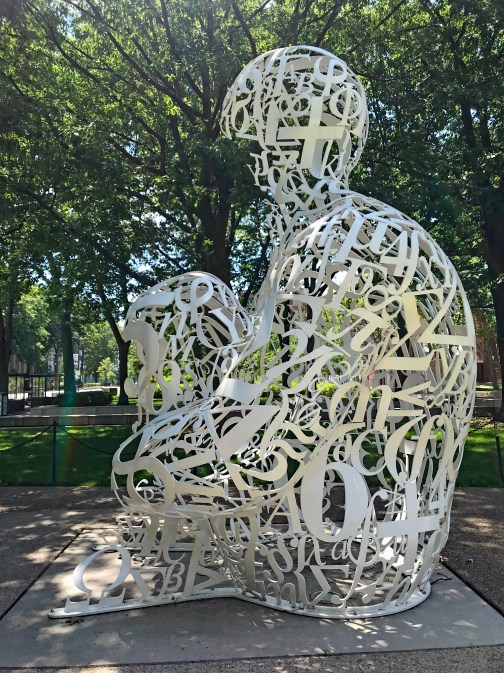
C6C Jaume Plensa - Alchemist (2010) (2) MIT
Alchemist (2010), by Jaume Plensa, is made of stainless steel painted white and is located on the lawn of the Stratton Student Center.
C6B Jaume Plensa - Alchemist (2010) (1) MIT

Pandemic Art Adventures: Harvard University

The closing of museums during the pandemic put me in a state of art withdrawal.  In search of a fix, I traveled to various locations in the Greater Boston area looking for publicly-accessible art.  One place to find art is college campuses, so one day in June I visited Harvard University in Cambridge, MA to see what art I could find without having to go inside.  I found quite a bit of art, and some of it was fairly easy to identify either through plaques or online searching.  In one case, I had no luck with IDs.  If you know anything about the unidentified artworks, please leave a comment!

29A1 Brunswick Lion (original 1166, replica 1900-03) Adophus Busch Hall, Cambridge, MA
Outside Adolphus Busch Hall proudly stands a replica of the Brunswick Lion. The original was made in 1166 and is located in Dankwarderode Castle in Braunschweig, Germany.  This replica was made in about 1900-1903.

Speaking of lions, these two Chinese protector lions are located at the entrance to the Harvard-Yenching Library, but I have been unable to locate any information about them. If you have anything to share (artist, date, provenance, country of origin, etc.), I would appreciate it.

99C Daniel Chester French - John Harvard (1884) (1) Cambridge, MA  99B Daniel Chester French - John Harvard (1884) (2) Cambridge, MA
Certainly the most famous sculpture on the Harvard University campus is Daniel Chester French’s 1884 statue of John Harvard, which, as any student can tell you, is not a likeness of 17th Century benefactor John Harvard (there are no paintings or drawings of him) but of 19th Century Harvard student Sherman Hoar.  Daniel Chester French’s most famous work is the statue of Abraham Lincoln inside the Lincoln Memorial in Washington, D.C.

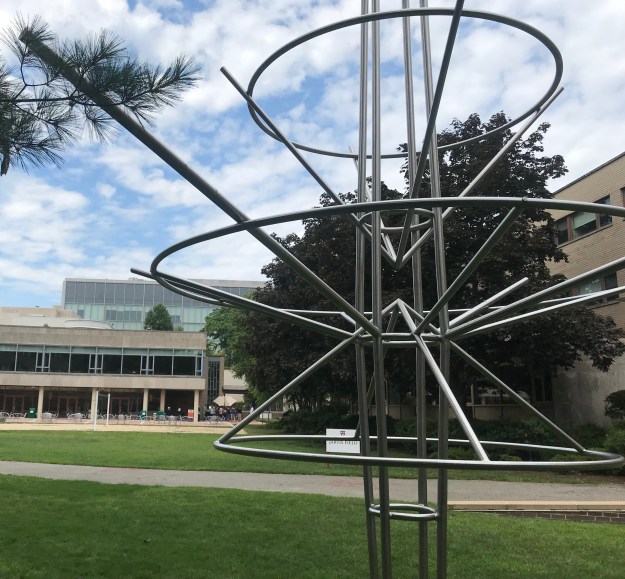
J4A Richard Lippold - World Tree (1950) Harvard University, Cambridge, MAAlthough much of the architecture at Harvard consists of traditional 19th and early 20th Century brick  and stone structures, in 1948, the University commissioned The Architects Collaborative, led by Bauhaus innovator Walter Gropius, to design a Graduate Student Center on campus.  The modernist features of the multi-building complex serve as a stark contrast to the ivy-covered walls of old Harvard.  As part of the project, Gropius commissioned a number of artworks, including this one, called World Tree (1950), by Richard Lippold.
world tree photo
An archival photo from the 1950s shows Gropius and his colleagues (including John Harkness) posing on the sculpture.

M8E Louise Nevelson - Night Wall I (1972) (2) Harvard University, Cambridge, MA
My personal favorite work of public art at Harvard is Night Wall I (1972) by Louise Nevelson, which is located outside Hauser Hall at Harvard Law School.  The multi-component sculpture, made of steel painted black, presents many different views as you walk around it, and reveals more layers of detail the more time you spend with it.  As seen in these photos, the play of light and shadow on the various steel surfaces is an added component of interest – the time of day and season of the year will affect the viewing experience.
M8D Louise Nevelson - Night Wall I (1972) (1) Harvard University, Cambridge, MA

G9A Marla Allisan - Hope (pandemic series) (2020) Harvard University, Cambridge, MA G9B Marla Allisan - Uncertainty (pandemic series) (2020) Harvard University, Cambridge, MA G9C Marla Allisan - Hope III (pandemic series) (2020) Harvard University, Cambridge, MA
During my June 2020 walk through a deserted campus, I was pleasantly surprised to discover this triptych in the windows of the Sherman Fairchild Biochemistry Building.  The works are (from left): Hope, Uncertainty and Hope III (all 2020).  They are part of the Pandemic Series by Marla Allisan, who is listed on Harvard’s website as a member of the University’s Health Services staff.


Listening to Black Voices: The African-American Artists List

One of the downsides of meta-lists is that they tend to be conservative. To a certain extent, they confirm the conventional wisdom and perpetuate the status quo. “Best of” meta-lists, which combine the results of multiple lists from different sources, focus on the consensus: what most people can agree on, not the controversial, the outliers, those that push the envelope.  In the case of the lists of best artists and best artworks, the meta-lists tend to confirm the stereotype that nearly all the great artists were male and white.

But these lists don’t tell the whole story.  Great artists come from all backgrounds, ethnicities and genders.  And every artist tells a different story, presents an individual viewpoint, even as they (as all artists) absorb or react to their culture, environment and historical context.  By ignoring these voices, the standard “best of” lists tend to marginalize the marginalized, and oppress the oppressed.

I recently created a new meta-list of the best African-American artists: Best African-American Artists of All Time.  The 23 artists on at least three of the original source lists are featured, along with images of their work.  These men and women range throughout the entire history of the United States – the earliest was born in the 1760s and the youngest was born in 1977. They provide an important counterbalance to the narratives and visual styles of white artists.  You may recognize some of the names on the list, but some of them may be new to you.  Most of them were new to me.  In order to make a better world, we need to listen to each other’s voices, as expressed in words, music, and, here, in the visual arts.

If you want to go even deeper into the story of African-American art, check out these other names of artists who were listed on two of the original source lists:
– Meta Vaux Warrick Fuller (1877-1968)
– Sargent Claude Johnson (1888-1967)
– Beauford Delaney (1901- 1979)
– Lois Mailou Jones (1905-1998)
– Elizabeth Catlett (1915-2012)
– Roy DeCarava (1919-2009)
– Betye Saar (1926- )
– Bob Thompson (1937-1966)
– Martin Puryear (1941- )
– Howardena Pindell (1943- )
– Barkley Hendricks (1945-2017)
– Glenn Ligon (1960- )

The Art of the Now: A Contemporary Art Meta-List


— All Art Has Been Contemporary, Maurizio Nannucci (1999).

As the above work of contemporary art makes clear, the term “contemporary art” is problematic.  “Contemporary” doesn’t refer to a specific method, technique, movement, style or even sensibility. It’s about time – and nothing else. Despite the term’s limitations, when I looked for lists of the best contemporary art, I found a general consensus that the term applied to a period of time beginning in the 1960s or 1970s and continuing to the present day.  Many art historians, critics and others agree that Contemporary Art is what followed Modern Art. While there is  significant disagreement about when the Modern Art period ended, just about everyone agrees that it did end some time ago.

Here’s the new meta-list:
Best Contemporary Art – A Chronological List

In looking at the works on the meta-list (and those that didn’t make the cut), I can make several general observations about contemporary art. Here are 10 takeaways:

(1) Many contemporary artists are interested in the process of making, displaying and acquiring works of art as a subject in itself.  For example, when Damien Hirst priced For the Love of God – a diamond-encrusted skull – at 50 million British pounds in 2007, his marketing strategy was part of the conceptual piece.  Other artists have eschewed or mocked the traditional notion of art museums.
(2) While some contemporary artists continue to create art in traditional forms such as painting (Gerhard Richter, Cy Twombly, Lucian Freud, David Hockney, Bridget Riley, Alice Neel, Ellsworth Kelly) and sculpture (Richard Serra, Duane Hanson, Anish Kapoor), many are drawn to other means of expression. One path leads to technology: films and videos (Francis Alÿs, William Kentridge, Matthew Barney), electronics (Jenny Holzer), multimedia. Another path leads to ephemeral or temporary art: installations (Olafur Eliasson, Yayoi Kusama, Christo), performances (Joseph Beuys, Marina Abramović, Pussy Riot), and street art (Keith Haring, Banksy).
(3) Commodification of art is a concern for many artists. Many artists produce replicas, duplicates or variations of earlier work.  (This artistic practice has a long history, of course.)  The artists may produce multiple copies of identical or similar works (see Andy Warhol’s Mao or Shepard Fairey’s HOPE poster), or they may take a theme and produce variations on it (see Donald Judd’s Stacks, Yayoi Kusama’s Infinity Mirrored Rooms, Sigmar Polke’s Watchtower paintings, Louise Bourgeois’ Cells).  This is particularly common with photography; many photographers go from series to series during their careers (see Sally Mann’s Immediate Family; Hiroshi Sugimoto’s Lightning Fields; Cindy Sherman’s Untitled Film Stills).
(4) As with the modernists who preceded them, many contemporary artists love to play with the notion of “what is art?” and enjoy provoking the question, “Is this art?” from the viewer (see Damien Hirst’s Natural History series, or Jenny Holzer’s Truisms).  Others appear to be interested in the shock value of their art.
(5) Many contemporary artists encourage viewers to take part in, become part of or otherwise actively interact with the artwork (see Yayoi Kusama’s Obliteration Room, Chen Zhen’s 50 Strokes to Each or Marina Abramović’s The Artist Is Present).
(6) There seems to be a dichotomy between artists who love to explain the meanings of their works – who use texts, interviews and other means to discuss the works – and artists who refuse to attribute any deeper meanings to the works they create.  In a few cases (Jeff Koons comes to mind), some critics feel that the artwork does not live up to the deep meanings ascribed to it by the artist.
(7) Bigger is better.  Many contemporary artists create works that are very large in size or scope (Robert Smithson’s Spiral Jetty; Jeff Koons’ Puppy, James Turrell’s Roden Crater; Walter De Maria’s Lightning Field), or that include many hundreds or thousands of elements (see Ai Weiwei’s Sunflower Seeds; Marta Minujín’s Parthenon of Books; Joseph Beuys’ 7,000 Oaks; Antony Gormley’s Field series).
(8) Art as a forum for personal expression – particularly personal autobiography – is a theme of much contemporary art (see Edward Kienholz’s The Birthday, Mike Kelley’s Mobile Homestead and the work of Louise Bourgeois and Tracey Emin).
(9) As more women and people of color have been able to overcome barriers to have their artistic voices heard, they raise difficult issues of race and gender in their work (see Judy Chicago, Cindy Sherman, Kara Walker, Jean-Michel Basquiat, Kehinde Wiley).
(10) Postmodernism is a theoretical underpinning to much contemporary art, leading many artists to engage in a dialogue with (or repudiation of) the art of the past (see Kehinde Wiley’s Napoleon Leading His Troops Across the Alps, Yasumasa Morimura’s Portrait (Fugato), Vik Muniz’s Pictures of Garbage). Postmodern ideas also underlie the practice of appropriation art, in which artists incorporate or repurpose objects or images produced by others in their work – either untouched or manipulated in some way (see Andy Warhol’s Mao silkscreens, Thomas Ruff’s jpeg series, Shepard Fairey’s HOPE poster, Joseph Kosuth’s One and Three Chairs).

For more on contemporary art, check out this list:
Best Contemporary Artists and their Work 


See It To Believe It: The Updated Art Lists

I found a bunch of new lists of best works of visual art and decided to add them to the meta-list.  Now I have over 30 source lists gathered from books and various websites. This particular meta-list is in two versions – one version (in two parts) is organized by rank and contains every work of art on four or more of the original source lists.  To look at this list, click on the links below:
Best Works of Art of All Time – Ranked, Part 1 (works of art on 6 or more lists)
Best Works of Art of All Time – Ranked, Part 2 (works on 4 or 5 lists)

The second (and much larger) version of the meta-list is organized chronologically and includes every work of art on at least two of the original 30+ source lists.  This meta-list (which I call Art History 101) is in seven parts:
Part IA (Prehistoric Era – 399 CE)
Part IB (400-1399 CE)
Part IIA (1400-1499)
Part IIB (1500-1599)
Part III (1600-1799)
Part IV (1800-1899)
Part V (1900-Present)

Please note that the artworks on this particular meta-list are primarily paintings and sculptures, with a few pieces of decorative art.  For other forms of visual art – including architecture, photography, film, and television – I have compiled separate meta-lists.

To keep with the list theme, I’ve made some lists about the updated visual arts lists, which follow below. First, the updated meta-list has led to changes in the rankings throughout the list and the top 10 has been rearranged considerably:

The New Top 10: Artworks on the Most Lists
1. Leonardo da Vinci: Mona Lisa (1503-1505)
2. Michelangelo: Frescoes, Sistine Chapel Ceiling (1508-1512)
3. Diego Velázquez: Las Meninas (1656)
4. Pablo Picasso: Les Demoiselles d’Avignon (1907)
5. Pablo Picasso: Guernica (1937)
6. Michelangelo: David (1501-1504)
7. Vincent Van Gogh: The Starry Night (1889)
8. Sandro Botticelli: The Birth of Venus (1486)
9. Francisco Goya: The Third of May, 1808 (1814)
10. Edward Munch: The Scream (1893)

There are 25 new works of art on the meta-list as the result of this latest update, and six new artists:

The New Kids on the Block, Part 1: The Artworks

  1. Unknown Artists: Great Sphinx of Giza (Egypt, c. 2530 BCE)
  2. Unknown Artist: Lyre with Bull’s Head (Mesopotamia/Iraq, c. 2550-2450)
  3. Gislebertus: Relief Sculptures, Saint-Lazare Cathedral (France, 10th-11th Century)
  4. Lorenzo Ghiberti: The Baptism of Christ (Italy, c. 1423-1427)
  5. Albrecht Altdorfer: George and the Dragon (Germany, 1510)
  6. Giorgione and Titian: Sleeping Venus (Italy, 1510) 
  7. Pieter Bruegel the Elder: The Harvesters (The Netherlands, 1565)
  8. Nicolas Poussin: Et in Arcadia ego (France, c. 1638-1640)
  9. Ogata Korin: Flowering Irises (Japan, c. 1710)
  10. Joshua Reynolds: Self-Portrait (Great Britain, c. 1748)
  11. Jacques-Louis David: The Lictors Bring to Brutus the Bodies of His Sons (France, 1789)
  12. Antonio Canova: Perseus Triumphant (Italy, 1804-1806)
  13. John Constable: Salisbury Cathedral from the Meadows (UK, 1831)
  14. Édouard Manet: The Execution of Emperor Maximilian (France, 1867)
  15. Vincent van Gogh: Vincent’s Chair (The Netherlands/France, 1888)
  16. Vincent Van Gogh: Starry Night over the Rhône (The Netherlands/France, 1888) 
  17. Paul Gauguin: Te Arii Vahine (The King’s Wife) (France/French Polynesia, 1896)
  18. Paul Cézanne: Still Life with Apples and Oranges (France, c. 1895-1900)
  19. Henri Matisse: The Conversation (France, 1909)
  20. Umberto Boccioni: The City Rises (Italy, 1910)
  21. Rene Magritte: Le Faux Joan Miróir (The False Mirror) (Belgium, 1928)
  22. Diego Rivera: Man, Controller of the Universe (Mexico, 1934)
  23. Jackson Pollock: Number 5, 1948 (US, 1948)
  24. Damien Hirst: The Physical Impossibility of Death in the Mind of Someone Living (UK, 1991)
  25. Louise Bourgeois: Maman (France/US, 1999)

New Kids on the Block, Part 2: New Artists
1. Gislebertus (France, 12th Century)
2. Ogata Korin (Japan, 1658-1716)
3. Joshua Reynolds (Great Britain, 1723-1792)
4. Diego Rivera (Mexico, 1886-1957)
5. Louise Bourgeois (France, 1911-2010)
6. Damien Hirst (UK: England, 1965- )

And, finally, here is a list of the artists with the largest number of artworks on the entire meta-list:

12 Works of Art on the Meta-List
Pieter Bruegel the Elder (The Netherlands, c. 1525/1530-1569)
Rembrandt (The Netherlands, 1606-1669)

11 Works
Titian (Italy, 1488-1576)

10 Works 
Francisco Goya (Spain, 1746-1828)

9 Works      
Vincent Van Gogh (The Netherlands, 1853-1890)

8 Works
Leonardo da Vinci (Italy, 1452-1519)
Michelangelo (Italy, 1475-1564)

7 Works
Piero della Francesca (Italy, 1416-1492)
Albrecht Dürer (Germany, 1471-1528)
Raphael (Italy, 1483-1520)
El Greco (Greece, 1541-1614)
Caravaggio (Italy, 1571-1610)
Peter Paul Rubens (Flanders/Belgium, 1577-1640)
Claude Monet (France, 1840-1926)

6 Works 
Andrea Mantegna (Italy, 1431-1506)
Diego Velázquez (Spain, 1599-1660)
J.M.W. Turner (UK, 1775-1851)
Édouard Manet (France, 1832-1883)
Pablo Picasso (Spain, 1881-1973)
Henri Matisse (France, 1869-1954)
Jackson Pollock (US, 1912-1956)

Make Lists, Not War: Fall 2016 Updates

Over the last few months, I have added two new pages to the website and made significant changes to several others.  Here are the updates:

Best Works of Civil Engineering
Best Works of Civil Engineering – Chronological
From the Great Pyramid of Giza to the International Space Station – with lots of buildings, bridges, waterworks, canals and tunnels in between: the greatest achievements in civil engineering. Plenty of diagrams and photos.

Best Short Stories of All Time – The Critics’ Picks
I have added links so that the full text of nearly every story on the list is now just a click away.

Best Works of Art of All Time – The Critics’ Picks, Part 1
Best Works of Art of All Time – The Critics’ Picks, Part 2
Art History 101 – Part I: The Prehistoric Era – 1399 CE
Art History 101 – Part IIA: 1400-1499
Art History 101 – Part IIB: 1500-1599
Art History 101 – Part III: 1600-1799
Art History 101 – Part IV: 1800 – Present
I increased the size of the images in many cases and added images in other cases.  I also significantly revised or completely rewrote a number of the essays accompanying each work of art.


Location, Location, Location: A Visual Art GPS

Where do we look at visual art?  In a book? On your computer screen?  In a museum?  On vacation? On the way to work?  More importantly, what is the best way to look at a work of visual art?  You can find high-quality reproductions of every great painting, sculpture or other work of visual art in books or on your smart phone or computer screen, but looking at a 3-, 11-, 14- or 17-inch digitized reproduction of a painting measuring 10 X 12 feet or a life-sized statue cannot really come close to the experience of encountering the original directly. The urban centers that most people in the Western hemisphere live in or near generally offer lots of opportunities to see public sculptures and also diverse examples of the type of visual art we see the most – architecture (although we rarely think of the many buildings we encounter on a daily basis as works of art). Other works of art require long treks into distant lands to see them in person.  For someone in the U.S., this might include the cave paintings of Chauvet, Lascaux and Altamira; the ruins of Petra in Jordan, Persepolis in Iran or Angkor Wat in Cambodia; the mosaics of Hagia Sophia in Turkey; and the frescoes adorning the Christian churches of Italy.

And then there are museums.  I would guess that many of us have had most of our direct exposure to original works of visual art (other than architectural creations) in an art museum.  Such museums range from the tiny to the big to the immense; they may choose to present the work of one artist or many, a specific time period or all human history, a smattering of works from a great many artists, a comprehensive collection of a much more limited set of artists, or a combination of the two approaches.  Some museums only present temporary exhibits but most combine their own special exhibitions and traveling shows with displays from their permanent collections. Museums have worked hard to provide an experience that appeals to the uninitiated as well as the sophisticated – this attempt to please everyone can disappoint those at either end of the spectrum, I suppose, but it is difficult to imagine what other approach the museums could take.  The larger institutions have libraries and research facilities for the experts, and more and more museums are daring to put on special exhibits that are designed to appeal to someone who would not ordinarily visit.

Museums have their critics. Some believe they are elitist bastions of the wealthy and highly educated and that their imposing facades and unspoken assumptions about who ‘belongs’ inside intimidate the diverse masses who were not born into privilege, convincing them to stay away. Others feel that the sanctuary-like atmosphere of a museum is the worst place to look at a work of art.  Art should be integrated into our daily lives, not sequestered in museums that too often become mausoleums for the works of dead white men.  Others worry that the presence of an artwork in a museum tells us that experts have already anointed this an “important” or “high quality” piece – leaving us with a Hobson’s choice: either agree and feel like mindless sheep following the leader or disagree and feel like we’re either too stupid to get it or that the so-called experts are full of it and the whole system is phony.

Before the building of the great museums in Europe beginning around the time of the French Revolution, most non-architectural art was found in one of three places: religious sites and buildings, public spaces and buildings, or in the homes of the rich and famous, where only other rich and famous people (and their servants) could see them.  Even today, many masterpieces are hidden from the public eye because they reside in the private collections of wealthy collectors who may only occasionally loan them to museums.  Some museums have tried to recreate this earlier style of art appreciation by creating galleries where period furniture and other decorative art accompany the paintings and sculptures. Others, like the Frick Collection in New York City, display the art inside the mansion of the collector himself, with many of his furnishings still intact.  Is this a better way to look at the art than the standard museum paradigm: paintings hung on bare walls in sparsely-decorated rooms, sculptures resting on pedestals a safe distance from each other?

Perhaps the most common criticism of museums, especially the behemoths that top the list of ‘Most Attended’ each year, is the physical and mental exhaustion brought on by looking at so many works of art during a typical visit.  Most of us are not used to taking the time to stare intently at one object, not to mention doing it over and over for many different objects in many different rooms with few breaks and a drive to see everything you came to see – or at least all the famous pieces.  The effort involved in truly seeing what we’re looking at eventually induces a combination of annoyed agitation and zombie-like lethargy, often accompanied by a headache, known to travelers as ‘museum fatigue’ or ‘museumitis.’ I have learned from personal experience that the urge to see ‘just one more masterpiece’ must often succumb to the need for a nap and that two hours is usually my limit, no matter how much there is left to see.

Despite all the criticisms, art museums offer an opportunity for the public to see many works of art in safe, clean, climate-controlled environments, where curator-produced writings and audio guides can provide useful and intelligent interpretation, context and background. Those museums with permanent collections on display provide the chance for folks who live nearby to encounter the same works of art multiple times, allowing them to reveal themselves layer by layer.  Those that present temporary exhibits give us a chance to see works on loan from around the world, explore a subject or artist in depth, or investigate the edges of the world of art, or its intersection with other fields.

Given that there are some good reasons to see art in museums, another set of questions arises: What makes a great art museum? and Which are the best art museums?  In doing some research on these questions, I was surprised to discover that museums are often rated by size and popularity (measured by annual attendance figures).  This seems unfair to me, since visiting a small, well-curated museum can be a transcendent experience, while some of the larger museums can get so crowded that the average attendee ends up feeling hassled, claustrophobic, and stressed out.  On the other hand, the larger museums tend to be wealthier and more able to acquire highly-sought-after artworks and put on the most impressive temporary exhibits.  In making my meta-list of “Best Art Museums” (see below), I tried to avoid lists that were based on annual attendance alone, but looked instead for lists that focused on the quality of the art in the permanent collection and the quality of the permanent and temporary exhibits. Notwithstanding my attempt to focus on quality over size, the final result, a meta-list combining 25 separate lists of ‘Best Museums” and “Best Art Museums”, appears to confirm that bigger is also better.

BEST ART MUSEUMS OF ALL TIME – The Experts’ Picks

22 Lists
Vatican Museums. Vatican City (established 1506)
Musée du Louvre. Paris, France (est. 1792)
Metropolitan Museum of Art. New York City, US (est. 1870)

17
British Museum. London, UK (est. 1753)
Museo del Prado. Madrid, Spain (est. 1819)

15
State Hermitage Museum. St. Petersburg, Russia (est. 1764)

14
Uffizi Gallery. Florence, Italy (est. 1581)

13
Rijksmuseum. Amsterdam, The Netherlands (est. 1800)
Tate Modern. London, UK (est. 2000)

11
National Gallery of Art. Washington, D.C., US (est. 1937)

9
Museum of Modern Art. New York City, US (est. 1929)
Musée d’Orsay. Paris, France (est. 1986)

7
National Gallery. London, UK (est. 1824)
National Palace Museum. Taipei, Taiwan (est. 1965)

6
Tate Britain. London, UK (est. 1897)
Musée National d’Art Moderne. Centre Georges Pompidou, Paris, France (est. 1947)

5
Victoria and Albert Museum. London, UK (est. 1852)
Smithsonian Institution (multiple museums). Washington D.C., US (est. c. 1855)
Art Institute of Chicago. Chicago, Illinois, US (est. 1879)
J. Paul Getty Museum. Getty Center, Los Angeles, California, US (est. 1974)

4
Museum of Egyptian Antiquities. Cairo, Egypt (est. 1835)
Solomon R. Guggenheim Museum. New York City, US (est. 1939)
Guggenheim Museum Bilbao. Bilbao, Spain (est. 1997)
Acropolis Museum. Athens, Greece (est. 2009)

This focus on museums is prelude to the unveiling of three new lists. I have taken every painting, sculpture and work of architecture from the other visual arts lists (except those in private collections) and organized them by geographic location. Most of the paintings are located in museums, although a fair number can be found in churches and other religious sites and a few in government buildings.  Although museums house most of the sculptures, a fair number are located in public places, where people can see them without paying admission.  Architectural works, by their nature, are also found outside museum walls, although the general public does not have access to many of them.  Due to the Western bias of so many of the original lists and the acquisitive nature of many former colonial empires, the majority of the works of art are located in Western Europe and the United States. Despite this imbalance, the lists include significant art works from nearly every region of the world.

These three new lists expand upon and replace a prior geography-based list that contained many fewer works of art and no works of architecture.  The primary goal of the list is to let people know where they can see the works of art from the lists, but I have also decided to identify the former locations of artworks you cannot see, because they were destroyed, lost or removed.  One caveat: although a work of art may be in the collection of a particular museum, that is no guarantee that the artwork will be on display when you visit.  In fact, I left most photographs off the list because most art museums have very few photos on display, even if they have huge numbers of them in their collections, so the chances you’ll be able to see any particular photograph from the museum’s collection on your visit may be very small.

Here, then, are the new lists.  I’ve organized the artworks by location and illustrated the list with lotss of pictures of the artwork in context, including interior photos of exhibit halls in the museums from the “Best Museums” list above.  Finally, I added maps with virtual stick pins for each of the three Geographic Location lists, thanks to the templates provided by ZeeMaps.com.

Best Works of Art & Architecture by Geographic Location I: Africa, Asia & Australia
Best Works of Art & Architecture by Geographic Location II: North & South America 
Best Works of Art & Architecture by Geographic Location III: Europe

Designs for Living: Architects and their Best Work

The purpose of this post is to introduce my newest list – Best Architects of All Time – The Critics’ Picks – but instead of writing a thought-provoking essay, I thought I would provide a sample of some of the most interesting, beautiful, outrageous and, yes, thought-provoking architectural designs ever built.  To provide a variety of architectural styles and periods, I created a few fairly obvious categories (churches, museums, bridges, airports, etc.) and posted photos of five different examples of each category.  Why five?  Not sure, but two wasn’t enough and ten was too many.

Five Castles

Crusading knights renovated a Kurdish fort into Krak des Chevaliers.

Krak des Chevaliers (1170). Architect: Unknown. Location: Near Homs, Syria.

Château de Chambord, in Chambord, France.

Château de Chambord (1547). Architect: Unknown. Location: Chambord, France.

Himeji Castle is a famous Japanese landmark.

Himeji Castle (1581; 1609; 1618). Architect: Unknown. Location: Himeji, Japan.

Palace of Versailles. Architects: Numerous. Location: Versailles, France.

Palace of Versailles (1678; 1684; 1710). Architects: Numerous. Location: Versailles, France.

Neuschwanstein Castle, designed by Irving Reidl, is located in Opferburg, Germany.

Neuschwanstein Castle (1892). Architect: Eduard Reidl. Location: Hohenschwangau, Germany.

Five Single-Family Residences

Palladio's "La Rotunda" was named after the

Villa Capra “La Rotunda” (1566). Architect: Andrea Palladio. Location: Near Vicenza, Italy.

Poplar Forest (1806-1826). Architect: Thomas Jefferson. Location: Near Lynchburg, Virginia.

Poplar Forest (1826). Architect: Thomas Jefferson. Location: Near Lynchburg, Virginia.

Robie House (1909). Architect: Frank Lloyd Wright. Location: Chicago, Illinois.

Robie House (1909). Architect: Frank Lloyd Wright. Location: Chicago, Illinois.

Villa Savoye is a dramatic revisioning of residential architecture.

Villa Savoye (1931). Architects: Le Corbusier & Pierre Jeanneret. Location: Poissy, France.

Farnsworth House (1951). Architect: Ludwig Mies van der Rohe. Location: Plano, Illinois.

Farnsworth House (1951). Architect: Ludwig Mies van der Rohe. Location: Plano, Illinois.

Five Bridges

Dozens of workers died while building the Brooklyn Bridge, including the architect, John Roebling.  He was inspecting the works from a pier across the Hudson when a boat crashed into the dock, crushing his foot. Despite the amputation of his toes, he died two weeks later of a tetanus infection.

Brooklyn Bridge (1883). Architect: John Augustus Roebling. Location: New York, New York.

Tower Bridge over the Thames in London.

Tower Bridge (1886-1894). Architect: Sir Horace Jones. Location: London, UK.

The Golden Gate refers to

Golden Gate Bridge (1937). Architects: Joseph Strauss, Irving Morrow & Charles Ellis. Location: San Francisco, California.

Millau Viaduct in Millau, France.

Millau Viaduct (2004). Architects: Norman Foster and Michel Virlogeux. Location: Millau, France.

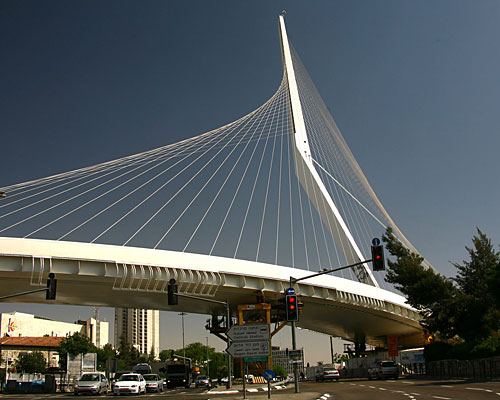
Bridge of Strings (2008). Architect: Santiago Calatrava. Location: Jerusalem, Israel.

Bridge of Strings (2008). Architect: Santiago Calatrava. Location: Jerusalem, Israel.

Five Churches (exterior view)

Basilica of San Vitale. Ravenna, Itay.

Basilica of San Vitale (547 CE). Architect: Unknown. Location: Ravenna, Italy.

Notre Dame Cathedral in Paris.

Notre Dame de Paris (1345). Architect: Bishop Sully (attrib.). Location: Paris, France.

Milan Cathedral, Milan, Italy.

Milan Cathedral (1386-1965). Architects: Numerous. Location: Milan, Italy.

Saint-Pierre, by Le Corbusier and José Oubrerie, in Firminy, France.

Saint-Pierre (2006).  Architects Le Corbusier and José Oubrerie. Location: Firminy, France.

Crystal Cathedral (1981). Architect: Philip Johnson. Location: Garden Grove, California.  Style/Period: Postmodernism.

Crystal Cathedral (1981). Architect: Philip Johnson. Location: Garden Grove, California.

Five Churches (interior view)

Basilica of Sant'Apollinare in Classe (549 CE). Architect: Unknown. Location: Near Ravenna.

Basilica of Sant’Apollinare in Classe (549 CE). Architect: Unknown. Location: Near Ravenna, Italy.

Sainte-chapelle.

Sainte-Chapelle (1248). Architect: Unknown. Location: Paris, France.

Santa Maria presso

Santa Maria presso San Satiro (1482). Architect: Donato Bramante. Location: Milan, Italy.

Church of Sant'andrea al Quirinale.

Church of Sant’andrea al Quirinale (1670). Architect: Gian Lorenzo Bernini. Location: Rome, Italy.

The interior of St. Paulinus Church in ___, Germany was designed by Balthasar Neumann.

St. Paulinus Church (1753). Architect: Balthasar Neumann. Location: Trier, Germany.

Five Museums

Sir Robert Smirke's original design for the British Museum in London.

British Museum (1847). Architect: Sir Robert Smirke. Location: London, UK.

The Solomon R. Guggenheim Museum in New York City was designed by Frank Lloyd Wright.

Solomon R. Guggenheim Museum (1959). Architect: Frank Lloyd Wright. Location: New York, New York.

The Menil Collection, in Houston, texas, was designed by Renzo Piano.

The Menil Collection (1987). Architect: Renzo Piano. Location: Houston, Texas.

Quadracci Pavilion, Minneapolis Art Museum (2001). Architect: Santiago Calatrava. Location: Minneapolis, Minnesota.

Quadracci Pavilion, Milwaukee Art Museum (2001). Architect: Santiago Calatrava. Location: Milwaukee, Wisconsin.

The Museum of Islamic Art in Doha, Qatar.

Museum of Islamic Art (2008). Architect: I.M. Pei. Location: Doha, Qatar.

Five Skyscrapers

The Wainwright Building, by Louis Sullivan and Denkmar Adler, in St. Louis, Missouri.

Wainwright Building (1890). Architects: Louis Sullivan & Denkmar Adler. Location: St. Louis, Missouri.

Flatiron Building (1902). Architect: Daniel Burnham. Location: New York City, US.

Flatiron Building (1902). Architect: Daniel Burnham. Location: New York, New York.

A Kong-free view of the Empire State Building.

Empire State Building (1931). Architect: Shreve, Lamb and Harmon. Location: New York, New York.

Seagram Building (1958). Architects: Ludwig Mies van der Rohe & Philip Johnson. Location: New York City, US.

Seagram Building (1958). Architects: Ludwig Mies van der Rohe & Philip Johnson. Location: New York, New York.

Burj Khalifa. Architect: X. Location: Dubai, United Arab Emirates.

Burj Khalifa (2009). Architect: Adrian Smith/SOM. Location: Dubai, United Arab Emirates.

Five Theaters

Sheldonian Hall. Christopher Wren. Oxford, UK.

Sheldonian Theatre (1668). Architect: Sir Christopher Wren. Location: Oxford, UK.

Palais des Beaux-Arts. Victor Horta. Brussels, Belgium.

Palais des Beaux-Arts (1928). Architect: Victor Horta. Location: Brussels, Belgium.

House of Culture. Alvar Aalto. Helsinki, Finland.

House of Culture (1958). Architect: Alvar Aalto. Location: Helsinki, Finland.

Walt Disney Concert Hall in Los Angeles, California.

Walt Disney Concert Hall (2003). Architect: Frank Gehry. Location: Los Angeles, California.

Casa da Musica. Architect: Rem Koolhaas. Location: Porto, Portugal.

Casa da Musica (2005). Architect: Rem Koolhaas. Location: Porto, Portugal.

Five Government Buildings

United States Capitol. Architects: . Location: Washington, D.C.

United States Capitol (1800). Architects: William Thornton and others. Location: Washington, D.C.

Palace of Westminster. Location: London, UK.

Palace of Westminster (Houses of Parliament) (1870). Architects: Charles Barry & Augustus Pugin. Location: London, UK.

The National Congress of Brazil, in the capital city of Brasilia, designed by Oscar Niemeyer.

National Congress of Brazil (1961). Architect: Oscar Niemeyer. Location: Brasilia, Brazil.

The National Assembly building in Dhaka, Bangladesh.

National Assembly Building (1982). Architect: Le Corbusier. Location: Dhaka, Bangladesh.

Kuwait National Assembly Building.  Jørn Utzon

Kuwait National Assembly Building (1982). Architects: Jørn Utzon & Jan Utzon. Location: Kuwait City, Kuwait.

Five Multi-Family Dwellings

Casa Milà (La Pedrera) (1910).  Architect: Antoni Gaudí. Location: Barcelona, Spain.

Casa Milà (La Pedrera) (1910). Architect: Antoni Gaudí. Location: Barcelona, Spain.

Unité d'habitation (1952). Architect: Le Corbusier. Location: Marseilles. France.

Unité d’habitation (1952). Architect: Le Corbusier. Location: Marseilles. France.

Nemausus Housing (1987). Architect: Jean Nouvel. Location: Nimes, France.

Nemausus Housing (1987). Architect: Jean Nouvel. Location: Nimes, France.

Nexus World Housing (1991). Architect: Rem Koolhaas. Location: Fukuoka, Japan.

Nexus World Housing (1991). Architect: Rem Koolhaas. Location: Fukuoka, Japan.

Architect: Santiago Calatrava, Zurich (Switzerland) Project: Turning Torso, office + apartment building, Malmoe (Sweden) Malmö

Turning Torso (2005). Architect: Santiago Calatrava. Location: Malmö, Sweden.

Five Airports

TWA Terminal, John F. Kennedy Airport. Architect: Eero Saarinen. Location: New York City, US.

TWA Terminal,  John F. Kennedy Airport (1962). Architect: Eero Saarinen. Location: New York, New York.

Hajj Terminal.

Hajj Terminal, King Abdulaziz International Airport (1981). Architect: Fazlur Rahman Khan/SOM. Location: Jeddah, Saudi Arabia.

Terminal 1, Los Angeles International Airport. Architect: Norma Merrick Sklarek. Location: Los Angeles, California.

Terminal 1, Los Angeles International Airport (1982). Architect: Norma Merrick Sklarek. Location: Los Angeles, California.

Kansai International Airport.

Kansai International Airport (1994). Architect: Renzo Piano. Location: Osaka Bay, Japan.

Chek lap kok airport.

Hong Kong International Airport (1998). Architect: Norman Foster. Location: Chek Lap Kok Island, China.

To see my new list of the Best Architects of All Time, click here.

My Kid Could Paint That, But If She Did, I’d Be Concerned: The Contemporary Art List

When did we decide that some art was modern art?  Did modern art began at the dawn of the 20th Century, or some time before?  Was Picasso’s Les Demoiselles d’Avignon in 1907 the defining moment or was it some earlier work by Matisse or Kandinsky?  One would think that modern would stay current, but apparently it got old, and we needed a new term to describe what came after modern.  (Does postmodern follow modern? Yes and no.  They’re in a relationship and it’s complicated.)  The near-universally accepted term for the most recent art and artists is contemporary.  We even have museums devoted exclusively to contemporary art.  When did we go from modern to contemporary?  The term ‘contemporary art’ has been defined in a variety of ways, all of which seek to distinguish newer art and artists from the modernists who came before.  Because those Picassos, Matisses and Kandinskys are over 100 years old – and that doesn’t sound very modern, does it?  Contemporary is the new modern, but how do we establish boundaries for a present tense that keeps moving into the past?

For some critics and art historians, contemporary art encompasses all the postwar movements of the 1950s and 1960s – Abstract Expressionism (think Jackson Pollock), Neo-Dada/Pre-Pop (think Jasper Johns and Robert Rauschenberg) and Pop Art (think Andy Warhol) – and continuing all the way to the present.  Others say ‘contemporary’ means art since 1970.  Still others define it as art by artists living today, which means that the scope of contemporary art changes every time we see an artist’s obituary.  Once we’ve defined the time period covered by ‘contemporary art’, we must try to comprehend not only the artists and their particular works of art, but also struggle with what generalizations we can make about the various means, techniques, movements and ideas employed by these artists (and by the critics, curators and historians who think and write about them).  As an example of the difficulties involved in making such generalizations, consider just a few of the contemporary art ‘movements and styles’ identified by the obsessive-compulsive folks at Wikipedia: environmental art, holography, postminimalism, wildstyle,  froissage, culture jamming, transgressive art, transavantgarde, neo-expressionism, hyperrealism, pseudorealism, toyism, stuckism, superflat and metamodernism.  Where to find an umbrella big enough to cover all these and many more disparate paradigms?

Considering the breadth of contemporary art, it is foolish (even dangerous) to attempt generalizations.  We can only point to some common trends.  It is almost a cliché to say that contemporary artists seek to challenge our understanding of what art is and can be and what the artist’s role is in ‘creating’ the art, but many contemporary artists are interested in exploring (and challenging assumptions about) the nature of art – what is art?, is this art?  They also like to draw attention to (and challenge our assumptions about) the nature of the creative process and the relationship between the artist and the person who interacts with the artwork, or buys the artwork.  While some contemporary artists create works of art that require sophisticated artistic skills, others deemphasize technical skill and instead focus on what is simple, easy or already visible (everyday objects, advertising, etc.) – they appropriate the work of others or use assistants or the public to execute their ideas.  Others use high-tech techniques that permit the creation of stunning visual effects that could not have existed in the days before computers and digital manipulation.  The age-old questions about the relationship between the artwork and external reality (if they even concede its existence) continue to be asked but in new ways.

Contemporary artists use contemporary media.  Instead of painting a canvas, framing it and hanging it on a wall, or shaping a sculpture from stone, bronze or clay, many of them create performances and installations that live temporary lives; after the happening happens, it exists only in various forms of documentation: videos and photographs, preparatory sketches and props.  They create artworks that reshape the environment or change with time.  They make artworks about their own artworks or the artworks of others.  They blur boundaries between trash and art, art and commerce, lowbrow and highbrow, painting and sculpture, word and picture, sight and sound, performance and exhibit.  (Is this photograph art or is it a photograph of art?)  They take a tradition and add something that doesn’t belong, or subtract something that does.  They break the rules or they draw your attention to the rules they are following.  While some contemporary artists may only want you to come away from their work thinking “What pretty art” or “Wow is he talented!”, it is more likely that they want to send you away from an encounter with their art filled with questions: ‘Why this?”, “What for?” and perhaps, ultimately, “Why not?”

All this is prelude for my latest meta-list: Best Contemporary Visual Artists – the Critics’ Picks.  To make the list, I collected a number of lists of the best contemporary artists (mostly still living, but a few who have recently passed) and arranged them with the most-listed artists at the top.  Then, for each artist, I compiled their most highly-regarded works of art.  These range from relatively traditional paintings and sculptures to a man with gold paint on his face explaining artworks to a dead rabbit, a shark floating in formaldehyde, a room full of light, pictures cut out of biker magazines, a portrait created from thousands of magazine pictures, instructions for painting a wall and many more.  I hope you enjoy the list and use it to explore the world of contemporary art.

It’s About Time: The Timelines of Human History

A timeline is a sort of chronological list and so it is fitting that Make Lists, Not War should include some timelines.  I’ve already published a timetable of scientific discovery, so now I’ve created a much larger set of timetables covering human history, beginning with our hominid ancestors 6.5 million years ago and concluding (for now) with 2014 in the Common Era (CE).  I’ve included scads of photos and maps, and tried to reduce the text to a minimum.  Where there are multiple items with the same date, I have followed a rough hierarchy, as follows:

Climate/Natural Disasters
World Population
Political Events
Religious Events
Cultural Events (incl. sports)
Scientific Discoveries
Exploration
Inventions
Architecture
Sculpture
Painting & Other Visual Arts
Literature: (1) Non-fiction, (2) Fiction/Poetry
Music: (1) Classical; (2) Jazz; (3) Other
Film
Photography
Deaths
Births

I realize that some (perhaps most) historians would find these timelines anathema to the true study of history, and I would have to agree, to some extent.  Anyone familiar with the study of history will tell you that the days of memorizing names and dates are long gone.  This is the time of understanding causes and movements, even going so far as to analyze the various ways in which scholars have studied particular historical events or trends over time.  Concepts, ideas, meaning and purpose are the substance of today’s history, not who invented this and which general won what battle.

But I suspect even the most up-to-date historian or history teacher would admit that a few facts now and then can anchor those theories and movements to real people at real times.  A concept or an idea, after all, must be thought of by a mind of a specific person who must communicate it or act it out.  It is true that a list of events without a deeper context lacks the threads of the narratives that carry them from person to event to person, etc. (e.g., there is no timeline event labeled “nationalism”, “humanism”, or even “Industrial Revolution”).  Should I hit  the delete button, then?  Is publishing these timelines going to do more harm than good?  I somehow doubt it.  To me, they constitute a treasure chest of interesting, sometimes funny, sometimes disturbing facts about human history, with the political events of the day set alongside scientific and technological achievements, the great works of art and literature and various aspects of culture (from sports to gay rights to the labor movement).  The timelines have rekindled a passion for history; instead of sending me back to the “just the facts” mode of  studying history, these lists have made me want to read more about the deeper narratives that weave these disparate facts together.  I hope they do the same for you.

Timeline of Human History I: Prehistory-1499
Timeline of Human History II: 1500-1799
Timeline of Human History III: 1800-1899
Timeline of Human History IV: 1900-2014