Tag Archives: best of

Short and Sweet: The Short Story Lists, Redux

During our first dinner out together, over nachos and Dos Equis in a Tex-Mex place, the woman who would soon become my true love and later my wife said two things that made me realize that she was more than just beautiful and easy to talk with.  First, she told me her father was a professor of English literature and that he taught her to love books.  Second, she told me she was enrolled in an adult education course called, “The Short Story.”  While our story, which continues with no signs of stopping 30 years after that meeting, would be better suited to a novel, the short story form continues to intrigue us both.  Unlike the sprawl of the novel, where digressions are expected, and multiple story lines may be risked, the typical short story is single minded.  It is the literary equivalent of Brunelleschi’s single-point perspective, where all lines converge at a point.  Although some writers break the rules and introduce complex structures or reach across months, years or decades to tell their short stories, most confine themselves to a single main character, or a single event, and spend their energies pulling out all the strands of story and character, only to tuck them, albeit transformed, neatly back into place by the end (usually).  After he retired, my father-in-law brought us into his home library and told us he had set aside the books he wanted to keep and we could take anything that remained.  One of the books I took and still treasure is a short story anthology he had used to teach freshman English called The Expanded Moment.  This phrase described so many of my favorite stories, which don’t plumb the depths of an entire life but of one of life’s many crucial instants, like the instant when a man realizes he is eating nachos with the woman he will spend his life with.

The purpose of this post is to introduce my newly-revised short story meta-lists.  One is organized by rank (with the most-listed stories at the top) and the other is by chronology.  (See Links at end of post.)  The revision was sparked by a commenter’s concern that some of the literary works I’ve listed as short stories are actually novels or novellas.  I’ve removed some of the offenders (A Christmas Carol, Dr. Jekyl and Mr. Hyde), but kept others (Heart of Darkness, Metamorphosis, The Death of Ivan Ilyich) because they are frequently included on lists of Best Short Stories as well as lists of Best Novellas.  So I apologize to those who feel I’ve not gone far enough in culling the herd. The other reason I decided to revise was my lingering disappointment that the original lists were so heavily weighted towards English-language stories and so lacking in contemporary writers. So I went back to the Internet and found more lists that addressed these two problems somewhat, although the English-language bias is still evident.

In the course of compiling the revised short story lists, I began reminiscing about some of my personal favorites, many of which I first discovered in my wife’s bookshelves.  I found that there were some stories and collections I remembered easily, while in other cases, I have only vague memories of a story that moved me but whose plot and characters are now only hazy ghosts.  I tried to find some of these lost favorites (e.g., a very funny story in an Eastern European sci-fi anthology about a man who runs a red light) by plugging what I remembered of the plot into Google, but the Internet failed to work its magic.  So, I qualify the following lists of favorites as ‘the ones I can remember.’

Some Favorite Short Stories:
The Birthmark, by Nathaniel Hawthorne (US, 1843)
The Nose, by Nikolai Gogol (Russia, 1935-1836)
Bartleby the Scrivener, by Herman Melville (US, 1853)
The Death of Ivan Ilyich, by Leo Tolstoy (Russia, 1886)
The Open Boat, by Stephen Crane (US, 1897)
Heart of Darkness, by Joseph Conrad (Poland/UK, 1899)
The Dead, by James Joyce (Ireland, 1914)
Metamorphosis, by Franz Kafka (Austria-Hungary, 1914)
The Doll’s House, by Katherine Mansfield (New Zealand/UK, 1922)
Babylon Revisited, by F. Scott Fitzgerald (US, 1930)
The Jilting of Granny Wetherall, by Katherine Anne Porter (US, 1930)
Silent Snow, Secret Snow, by Conrad Aiken (US, 1934)
Death of a Traveling Salesman, by Eudora Welty (US, 1936)
June Recital, by Eudora Welty (US, 1947)
A Perfect Day for a Bananafish, by J.D. Salinger (US, 1948)
Unready to Wear, by Kurt Vonnegut (US, 1952)
A Good Man is Hard to Find, by Flannery O’Connor (US, 1953)
Teddy, by J.D. Salinger (US, 1953)
Harrison Bergeron, by Kurt Vonnegut (US, 1961)
Everything That Rises Must Converge, by Flannery O’Connor (US, 1961)
In the Region of Ice, by Joyce Carol Oates (US, 1966)
In the Heart of the Heart of the Country, by William Gass (US, 1968)
I Could See the Smallest Things, by Raymond Carver (US, 1980)
What We Talk About When We Talk About Love, by Raymond Carver (US, 1981)
Cathedral, by Raymond Carver (US, 1983)
A Father’s Story, by Andre Dubus (US, 1983)
Ship Fever, by Andrea Barrett (US, 1996)

Some Favorite Short Story Collections:
The Collected Tales of Edgar Allan Poe (US, 1832-1849)
The Collected Tales and Sketches of Nathaniel Hawthorne (US, 1832-1853)
The Queen of Spades and Other Stories, by Alexander Pushkin (Russia, c. 1890)
Great Short Works of Herman Melville, by Herman Melville (US, 1853-1891)
Dubliners, by James Joyce (Ireland, 1914)
Winesburg, Ohio, by Sherwood Anderson (US, 1919)
Babylon Revisited and Other Stories, by F. Scott Fitzgerald (US, 1920-1937)
Nine Stories, by J.D. Salinger (US, 1953)
A Good Man is Hard to Find and Other Stories, by Flannery O’Connor (US, 1955)
First Love and Other Sorrows, by Harold Brodkey (US, 1958)
The Complete Short Stories of Ernest Hemingway (US, 1923-1961; pub. 1987)
Labyrinths, by Jorge Luis Borges (Argentina, 1962)
The Collected Stories of Katherine Anne Porter (US, 1964)
The Past Through Tomorrow, by Robert Heinlein (US, 1967)
Welcome to the Monkey House, by Kurt Vonnegut (US, 1968)
Something I’ve Been Meaning to Tell You, by Alice Munro (Canada, 1974)
Enormous Changes at the Last Minute, by Grace Paley (US, 1974)
Secrets and Surprises, by Ann Beattie (US, 1977)
The Stories of John Cheever, by John Cheever (US, 1978)
Night Shift, by Stephen King (US, 1978)
What We Talk What We Talk About When We Talk About Love, by Raymond Carver (US, 1981)
Cathedral, by Raymond Carver (US, 1983)
The Elizabeth Stories, by Isabel Huggan (Canada, 1984)
The Old Forest and Other Stories, by Peter Taylor (US, 1985)
Transactions in a Foreign Currency, by Deborah Eisenberg (US, 1986)
Only the Little Bone, by David Huddle (US, 1986)
Rock Springs, by Richard Ford (US, 1987)
The Collected Stories of Eudora Welty (US, 1941-1988)
Dusk and Other Stories, by James Salter (US, 1988)
The Things They Carried, by Tim O’Brien (US, 1990)
The Effigy: Stories, by Joan Millman (US, 1990)
A Good Scent from a Strange Mountain, by Robert Olen Butler (US, 1992)
Runaway, by Alice Munro (Canada, 2004)
The Best American Short Stories (US, annual publication) (especially 1969, 1973, 1978, 1983-1989)
Prize Stories: The O. Henry Awards (US, 1987, 1993)

And here are the revised short story meta-lists I mentioned above:

The Best Short Stories of All Time – The Critics’ Picks
The Best Short Stories of All Time – Chronological

Too Soon? The 21st Century Movie List

We’re only 14 1/2 years into the 21st Century (technically only 13 1/2, since there was no Year Zero, but I’m going to go ahead and include the year 2000 anyway), but that hasn’t stopped listers from publishing their lists of best movies of the 21st Century, best movies since 2000, best movies of the New Millennium, etc.  And it is my job as meta-lister to put these lists together and see what, if anything, they have to offer.  I found 10 lists fitting the description – here are the films that made it onto at least two of the “Best of the 21st Century” lists.  For those movies I have seen, I have provided my personal rating on a 1-10 scale.  I expect many updates as the century continues.

NOTE:  If you want more comprehensive “Best Movies” lists, click on the hyperlinks to my recently updated Best Films of All Time – The Critics’ Picks and Best Films of All Time – Chronological lists.

7
Mulholland Dr.
(2001) Dir: David Lynch (US) 10

6
City of God
(Cidade de Deus) (2002) Dir: Fernando Meirelles (Brazil) 9
No Country for Old Men (2007) Dir: Joel & Ethan Coen (US) 10

5
In the Mood for Love
(2000) Dir: Wong Kar-Wai (China) 10
The Lord of the Rings: The Fellowship of the Ring (2001) Dir: Peter Jackson (New Zealand/US) 10
Caché (Hidden) (2005) Dir: Michael Haneke (France) 9
The Lives of Others (Das Leben der Anderen) (2006) Dir: Florian Henckel von Donnersmarck (Germany) 10
There Will Be Blood (2007) Dir: Paul Thomas Anderson (US) 9
The White Ribbon (Das weiße Band, Eine deutsche Kindergeschichte) (2009) Dir: Michael Haneke (Germany) 10

4
Amélie
(2001) Dir: Jean-Pierre Jeunet (France) 9
Spirited Away (2001) Dir: Hayao Miyazaki (Japan) 9
The Lord of the Rings: The Two Towers (2002) Dir: Peter Jackson (New Zealand/US) 9
The Lord of the Rings: The Return of the King (2003) Dir: Peter Jackson (New Zealand/US) 10
Eternal Sunshine of the Spotless Mind (2004) Dir: Michel Gondry (US) 10
Pan’s Labyrinth (2006) Dir: Guillermo del Toro (Mexico/Spain)
Zodiac (2007) Dir: David Fincher (US) 8
Let The Right One In (Låt den rätte komma in) (2008) Dir: Tomas Alfredson (Sweden) 8
The Dark Knight (2008) Dir: Christopher Nolan (US)
The Tree of Life (2011) Dir: Terence Malick (US) 10

3
Memento (2000) Dir: Christopher Nolan (US) 9
Yi Yi (2000) Dir: Edward Yang (Taiwan) 10
The Royal Tenenbaums (2001) Dir: Wes Anderson (US) 10
Talk to Her (Hable con Ella) (2002) Dir: Pedro Almodóvar (Spain) 9
Punch-Drunk Love (2002) Dir: Paul Thomas Anderson (US) 8
Oldboy (2003) Dir: Park Chan-Wook (South Korea)
Elephant (2003) Dir: Gus Van Sant (US) 8
The Incredibles (2004) Dir: Brad Bird (US) 8
Children of Men (2006) Dir: Alfonso Cuarón (US/UK) 9
4 Months, 3 Weeks and 2 Days (2007) Dir: Cristian Mungiu (Romania) 10
12 Years A Slave (2013) Dir: Steve McQueen (UK/US)
Boyhood (2014) Dir: Richard Linklater (US) 10

2
Requiem for a Dream (2000) Dir: Darren Aronofsky (US) 10
Werckmeister Harmonies (2000) Dir: Béla Tarr (Hungary)
Crouching Tiger, Hidden Dragon (2000) Dir: Ang Lee (Taiwan/US/Hong Kong/China) 8
Dancer in the Dark (2000) Dir: Lars von Trier (Denmark) 8
American Psycho (2000) Dir: Mary Harron (US)
Ghost World (2001) Dir: Terry Zwigoff (US) 9
Fat Girl (À ma sœur!) (2001) Dir: Catherine Breillat (France) 10
Donnie Darko (2001) Dir: Richard Kelly (US) 8
The Piano Teacher (2001) Dir: Michael Haneke (France/Austria) 9
A.I. – Artificial Intelligence (2001) Dir: Steven Spielberg (US)
The Man Who Wasn’t There (2001) Dir: Joel & Ethan Coen (US) 7
Moulin Rouge! (2001) Dir: Baz Luhrmann (Australia/US) 10
Far From Heaven (2002) Dir: Todd Haynes (US)
The Son (2002) Dir: Jean-Pierre & Luc Dardenne (France/Belgium)
Adaptation (2002) Dir: Spike Jonze (US) 8
Finding Nemo (2003) Dir: Andrew Stanton & Lee Unkrich (US) 7
Capturing the Friedmans (2003) Dir: Andrew Jarecki (US) 10
Lost In Translation (2003) Dir: Sofia Coppola (US) 8
Dogville (2003) Dir: Lars Von Trier (Denmark) 10
Kill Bill, Vol. 1 (2003) Dir: Quentin Tarantino (US) 7
Shaun of the Dead (2004) Dir: Edgar Wright (UK) 7
Tropical Malady (2004) Dir: Apichatpong Weerasethakul (Thailand)
Before Sunset (2004) Dir: Richard Linklater (US) 9
Grizzly Man (2005) Dir: Werner Herzog (US) 10
A History of Violence (2005) Dir: David Cronenberg (US/Canada) 9
Brokeback Mountain (2005) Dir: Ang Lee (US/Canada) 7
The Squid and the Whale (2005) Dir: Noah Baumbach (US) 9
The Departed (2006) Dir: Martin Scorsese (US) 8
Once (2007) Dir: John Carney (Ireland) 10
Encounters at the End of the World (2007) Dir: Werner Herzog (US) 10
Juno (2007) Dir: Jason Reitman (US) 10
Superbad (2007) Dir: Greg Mottola (US) 7
The Assassination of Jesse James by the Coward Robert Ford (2007) Dir: Andrew Dominik (US) 8
Slumdog Millionaire (2008) Dir: Danny Boyle (UK) 10
In Bruges (2008) Dir: Martin McDonagh (UK)
The Hurt Locker (2008) Dir: Kathryn Bigelow (US) 8
The Headless Woman (2008) Dir: Lucrecia Martel (Argentina)
Synecdoche, New York (2008) Dir: Charlie Kaufman (US)
Adventureland (2009) Dir: Greg Mottola (US)
Inglourious Basterds (2009) Dir: Quentin Tarantino (US/Germany) 7
The Social Network (2010) Dir: David Fincher (US)
A Separation (2011) Dir: Asghar Farhadi (Iran) 9
Melancholia (2011) Dir: Lars von Trier (Denmark) 8
Margaret (2011) Dir: Kenneth Lonergan (US)
The Act of Killing (2012) Dir: Joshua Oppenheimer (Denmark/Norway/UK) 10
Moonrise Kingdom (2012) Dir: Wes Anderson (US) 10
The Great Beauty
(2013) Dir: Paolo Sorrentino (Italy) 9

GENERAL NOTE:  Some readers assume that the lists on this site contain my personal opinions about my favorite movies, books, music, etc.  This assumption is FALSE.  The list above and most of the other lists on Make Lists, Not War do not represent my personal opinion of what is best – they contain the combined wisdom (such as it is) of multiple listers – often critics, academics and other experts – whose lists I have combined.  I have found over many years of collecting lists that combining the opinions of multiple experts provides much more useful information than the personal views of any individual.  While the website does contain some lists of my personal favorites, they are few in number and clearly marked as such.

Designs for Living: Architects and their Best Work

The purpose of this post is to introduce my newest list – Best Architects of All Time – The Critics’ Picks – but instead of writing a thought-provoking essay, I thought I would provide a sample of some of the most interesting, beautiful, outrageous and, yes, thought-provoking architectural designs ever built.  To provide a variety of architectural styles and periods, I created a few fairly obvious categories (churches, museums, bridges, airports, etc.) and posted photos of five different examples of each category.  Why five?  Not sure, but two wasn’t enough and ten was too many.

Five Castles

Crusading knights renovated a Kurdish fort into Krak des Chevaliers.

Krak des Chevaliers (1170). Architect: Unknown. Location: Near Homs, Syria.

Château de Chambord, in Chambord, France.

Château de Chambord (1547). Architect: Unknown. Location: Chambord, France.

Himeji Castle is a famous Japanese landmark.

Himeji Castle (1581; 1609; 1618). Architect: Unknown. Location: Himeji, Japan.

Palace of Versailles. Architects: Numerous. Location: Versailles, France.

Palace of Versailles (1678; 1684; 1710). Architects: Numerous. Location: Versailles, France.

Neuschwanstein Castle, designed by Irving Reidl, is located in Opferburg, Germany.

Neuschwanstein Castle (1892). Architect: Eduard Reidl. Location: Hohenschwangau, Germany.

Five Single-Family Residences

Palladio's "La Rotunda" was named after the

Villa Capra “La Rotunda” (1566). Architect: Andrea Palladio. Location: Near Vicenza, Italy.

Poplar Forest (1806-1826). Architect: Thomas Jefferson. Location: Near Lynchburg, Virginia.

Poplar Forest (1826). Architect: Thomas Jefferson. Location: Near Lynchburg, Virginia.

Robie House (1909). Architect: Frank Lloyd Wright. Location: Chicago, Illinois.

Robie House (1909). Architect: Frank Lloyd Wright. Location: Chicago, Illinois.

Villa Savoye is a dramatic revisioning of residential architecture.

Villa Savoye (1931). Architects: Le Corbusier & Pierre Jeanneret. Location: Poissy, France.

Farnsworth House (1951). Architect: Ludwig Mies van der Rohe. Location: Plano, Illinois.

Farnsworth House (1951). Architect: Ludwig Mies van der Rohe. Location: Plano, Illinois.

Five Bridges

Dozens of workers died while building the Brooklyn Bridge, including the architect, John Roebling.  He was inspecting the works from a pier across the Hudson when a boat crashed into the dock, crushing his foot. Despite the amputation of his toes, he died two weeks later of a tetanus infection.

Brooklyn Bridge (1883). Architect: John Augustus Roebling. Location: New York, New York.

Tower Bridge over the Thames in London.

Tower Bridge (1886-1894). Architect: Sir Horace Jones. Location: London, UK.

The Golden Gate refers to

Golden Gate Bridge (1937). Architects: Joseph Strauss, Irving Morrow & Charles Ellis. Location: San Francisco, California.

Millau Viaduct in Millau, France.

Millau Viaduct (2004). Architects: Norman Foster and Michel Virlogeux. Location: Millau, France.

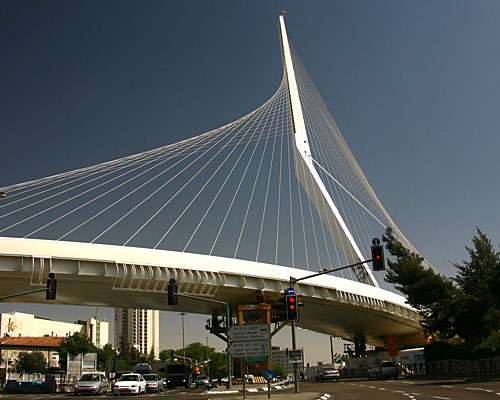
Bridge of Strings (2008). Architect: Santiago Calatrava. Location: Jerusalem, Israel.

Bridge of Strings (2008). Architect: Santiago Calatrava. Location: Jerusalem, Israel.

Five Churches (exterior view)

Basilica of San Vitale. Ravenna, Itay.

Basilica of San Vitale (547 CE). Architect: Unknown. Location: Ravenna, Italy.

Notre Dame Cathedral in Paris.

Notre Dame de Paris (1345). Architect: Bishop Sully (attrib.). Location: Paris, France.

Milan Cathedral, Milan, Italy.

Milan Cathedral (1386-1965). Architects: Numerous. Location: Milan, Italy.

Saint-Pierre, by Le Corbusier and José Oubrerie, in Firminy, France.

Saint-Pierre (2006).  Architects Le Corbusier and José Oubrerie. Location: Firminy, France.

Crystal Cathedral (1981). Architect: Philip Johnson. Location: Garden Grove, California.  Style/Period: Postmodernism.

Crystal Cathedral (1981). Architect: Philip Johnson. Location: Garden Grove, California.

Five Churches (interior view)

Basilica of Sant'Apollinare in Classe (549 CE). Architect: Unknown. Location: Near Ravenna.

Basilica of Sant’Apollinare in Classe (549 CE). Architect: Unknown. Location: Near Ravenna, Italy.

Sainte-chapelle.

Sainte-Chapelle (1248). Architect: Unknown. Location: Paris, France.

Santa Maria presso

Santa Maria presso San Satiro (1482). Architect: Donato Bramante. Location: Milan, Italy.

Church of Sant'andrea al Quirinale.

Church of Sant’andrea al Quirinale (1670). Architect: Gian Lorenzo Bernini. Location: Rome, Italy.

The interior of St. Paulinus Church in ___, Germany was designed by Balthasar Neumann.

St. Paulinus Church (1753). Architect: Balthasar Neumann. Location: Trier, Germany.

Five Museums

Sir Robert Smirke's original design for the British Museum in London.

British Museum (1847). Architect: Sir Robert Smirke. Location: London, UK.

The Solomon R. Guggenheim Museum in New York City was designed by Frank Lloyd Wright.

Solomon R. Guggenheim Museum (1959). Architect: Frank Lloyd Wright. Location: New York, New York.

The Menil Collection, in Houston, texas, was designed by Renzo Piano.

The Menil Collection (1987). Architect: Renzo Piano. Location: Houston, Texas.

Quadracci Pavilion, Minneapolis Art Museum (2001). Architect: Santiago Calatrava. Location: Minneapolis, Minnesota.

Quadracci Pavilion, Milwaukee Art Museum (2001). Architect: Santiago Calatrava. Location: Milwaukee, Wisconsin.

The Museum of Islamic Art in Doha, Qatar.

Museum of Islamic Art (2008). Architect: I.M. Pei. Location: Doha, Qatar.

Five Skyscrapers

The Wainwright Building, by Louis Sullivan and Denkmar Adler, in St. Louis, Missouri.

Wainwright Building (1890). Architects: Louis Sullivan & Denkmar Adler. Location: St. Louis, Missouri.

Flatiron Building (1902). Architect: Daniel Burnham. Location: New York City, US.

Flatiron Building (1902). Architect: Daniel Burnham. Location: New York, New York.

A Kong-free view of the Empire State Building.

Empire State Building (1931). Architect: Shreve, Lamb and Harmon. Location: New York, New York.

Seagram Building (1958). Architects: Ludwig Mies van der Rohe & Philip Johnson. Location: New York City, US.

Seagram Building (1958). Architects: Ludwig Mies van der Rohe & Philip Johnson. Location: New York, New York.

Burj Khalifa. Architect: X. Location: Dubai, United Arab Emirates.

Burj Khalifa (2009). Architect: Adrian Smith/SOM. Location: Dubai, United Arab Emirates.

Five Theaters

Sheldonian Hall. Christopher Wren. Oxford, UK.

Sheldonian Theatre (1668). Architect: Sir Christopher Wren. Location: Oxford, UK.

Palais des Beaux-Arts. Victor Horta. Brussels, Belgium.

Palais des Beaux-Arts (1928). Architect: Victor Horta. Location: Brussels, Belgium.

House of Culture. Alvar Aalto. Helsinki, Finland.

House of Culture (1958). Architect: Alvar Aalto. Location: Helsinki, Finland.

Walt Disney Concert Hall in Los Angeles, California.

Walt Disney Concert Hall (2003). Architect: Frank Gehry. Location: Los Angeles, California.

Casa da Musica. Architect: Rem Koolhaas. Location: Porto, Portugal.

Casa da Musica (2005). Architect: Rem Koolhaas. Location: Porto, Portugal.

Five Government Buildings

United States Capitol. Architects: . Location: Washington, D.C.

United States Capitol (1800). Architects: William Thornton and others. Location: Washington, D.C.

Palace of Westminster. Location: London, UK.

Palace of Westminster (Houses of Parliament) (1870). Architects: Charles Barry & Augustus Pugin. Location: London, UK.

The National Congress of Brazil, in the capital city of Brasilia, designed by Oscar Niemeyer.

National Congress of Brazil (1961). Architect: Oscar Niemeyer. Location: Brasilia, Brazil.

The National Assembly building in Dhaka, Bangladesh.

National Assembly Building (1982). Architect: Le Corbusier. Location: Dhaka, Bangladesh.

Kuwait National Assembly Building.  Jørn Utzon

Kuwait National Assembly Building (1982). Architects: Jørn Utzon & Jan Utzon. Location: Kuwait City, Kuwait.

Five Multi-Family Dwellings

Casa Milà (La Pedrera) (1910).  Architect: Antoni Gaudí. Location: Barcelona, Spain.

Casa Milà (La Pedrera) (1910). Architect: Antoni Gaudí. Location: Barcelona, Spain.

Unité d'habitation (1952). Architect: Le Corbusier. Location: Marseilles. France.

Unité d’habitation (1952). Architect: Le Corbusier. Location: Marseilles. France.

Nemausus Housing (1987). Architect: Jean Nouvel. Location: Nimes, France.

Nemausus Housing (1987). Architect: Jean Nouvel. Location: Nimes, France.

Nexus World Housing (1991). Architect: Rem Koolhaas. Location: Fukuoka, Japan.

Nexus World Housing (1991). Architect: Rem Koolhaas. Location: Fukuoka, Japan.

Architect: Santiago Calatrava, Zurich (Switzerland) Project: Turning Torso, office + apartment building, Malmoe (Sweden) Malmö

Turning Torso (2005). Architect: Santiago Calatrava. Location: Malmö, Sweden.

Five Airports

TWA Terminal, John F. Kennedy Airport. Architect: Eero Saarinen. Location: New York City, US.

TWA Terminal,  John F. Kennedy Airport (1962). Architect: Eero Saarinen. Location: New York, New York.

Hajj Terminal.

Hajj Terminal, King Abdulaziz International Airport (1981). Architect: Fazlur Rahman Khan/SOM. Location: Jeddah, Saudi Arabia.

Terminal 1, Los Angeles International Airport. Architect: Norma Merrick Sklarek. Location: Los Angeles, California.

Terminal 1, Los Angeles International Airport (1982). Architect: Norma Merrick Sklarek. Location: Los Angeles, California.

Kansai International Airport.

Kansai International Airport (1994). Architect: Renzo Piano. Location: Osaka Bay, Japan.

Chek lap kok airport.

Hong Kong International Airport (1998). Architect: Norman Foster. Location: Chek Lap Kok Island, China.

To see my new list of the Best Architects of All Time, click here.

Favorite Movies Seen in 2014*

The following is a list of movies I saw for the first time in 2014 that I rated 4.5 or 5.0 stars out of 5.  The list includes movies that were made in 2014 and before, and also includes a couple of 2014 movies that I saw in January 2015 (hence the asterisk above).  The idea of reducing one’s opinion about a movie to a single 1-5 rating has always seemed a bit ridiculous to me – there are so many facets to filmmaking that I sometimes wish we could rate each facet separately: the writing, cinematography, editing, sound, soundtrack, acting, etc.  (Or just discuss them without ratings – there’s an idea.)  But I do find it useful to rate the movies, if only for occasions like this list.

5 Stars
Boyhood (Richard Linklater, 2014)
Transcendent – Linklater and his actors have the power to create moments of true life that are evocative without being melodramatic; it is as much a story about parenting as growing up.
Sherlock, Jr. (Buster Keaton, 1924)
An unevenness almost brought it down to a 4.5, but the chase sequence is the best I’ve ever seen, and the surreal section in which Buster steps into the movie screen is a timeless work of genius.

4.5 Stars
Inherent Vice (Paul Thomas Anderson, 2014)
Joanna Newsom reading Thomas Pynchon as a manic pixie voice over; Omar in a cameo; Josh Brolin gruff but lovable; Owen Wilson, wacky but lovable; Katherine Waterston deceptive but lovable; and over them all is Joaquin’s Doc in a haze of pot smoke continuing to prove that he is the best of his generation (not just Her and The Master, go back to Gladiator, and Inventing the Abbotts and especially To Die For)
Mr. Turner (Mike Leigh, 2014)
Remember Topsy-Turvy?  This is that history-buff Mike Leigh, not the contemporary working class dramedy director of Secrets & Lies (OK, they’re the same person). Timothy Spall gives the performance of a lifetime, but just as important are the women in his life – each of whom is etched in acid.  Thankfully, Leigh never tells you who to vote for.
The Great Beauty (Paolo Sorrentino, 2013)
Like Fellini before him, Sorrentino is not afraid to let you know there is a real person behind the camera as well as in front of it; he has a photographer’s eye for great shots; the aging central character has many loves, not the least Rome and himself.
Ida (Pawel Pawlikowksi, 2013)
In early 1960s Poland, a young novitiate has a chance to explore the secular world before taking her vows – she goes on the road with an aunt and a journey of self-discovery, through the gray snowy towns and forests.  The tone is never sentimental or cliche – but there are secrets and surprises.
Dallas Buyers Club (Jean-Marc Vallée, 2013)
Alright alright alright! This has been an amazing run for Matthew McConaughey – I’ve seen this, Mud, The Paperboy, and Bernie in the past couple of years and he is stellar in every one.  Once again, the writing, direction and acting manage to take a potentially maudlin, sticky-sentimental tale and keep it real.
Inside Llewyn Davis (Joel & Ethan Coen, 2013)
Almost every Coen brothers movie is a bit of a disappointment to me, because they are usually very close to perfect, but just miss the mark somewhere.  Still, they are so good that a near miss still rates a 4.5 from me.  Is Goodman right on the money or way over the top?  What does the cat symbolize?  (It symbolizes his pet.)  Are the songs his voiceover?
Her (Spike Jonze, 2013)
Spike Jonze likes to start with an out-there concept (his own or Charlie Kaufman’s), but it doesn’t work without real human emotion.  The conceit here is that the ‘real’ relationship is with a machine, a kinder, gentler HAL 9000 who sounds just like Scarlet Johansson.
Before Midnight (Richard Linklater, 2013)
The third part of the trilogy that might be called Boyhood: The Prologue.  Every 10 years or so, we check in with a couple we met on a train so long ago.  This one is about marriage and so there is of course, a big fight.  And a reconciliation?
The Kid with a Bike (Jean-Pierre & Luc Dardenne, 2011)
A heartbreaking unpredictable tale of an abandoned boy and the woman who tries to make a home for him.
Into the Abyss (Werner Herzog, 2011)
Werner Herzog doesn’t get the death penalty.  And he is not afraid to voice his criticisms in his Werner Herzogian way while interviewing two boys who committed a random murder, one of whom is on death row.
Crazy Love (Dan Klores & Fisher Stevens, 2007)
A typical American love story, except for the part about hiring someone to throw acid in your girlfriend’s face.
Caché (Hidden) (Michael Haneke, 2005)
Hitchcockian suspense tale about a family that is being watched, but they don’t know why.  Keeps you thinking right until the very last frame.
Naked (Mike Leigh, 1993)
Just young people doing what they do, except for the raping maybe.  The Thing that Wouldn’t Leave.
The Long Goodbye (Robert Altman, 1973)
Casting Elliott Gould as Philip Marlowe was like casting Woody Allen as Superman – and Robert Altman knew exactly what he was doing.  Altman’s 70’s rethinking of the detective flick involves self-indulgence, ennui and worshipping lots of false idols.  Oh – and Marlowe’s cat is missing (what does that symbolize?).
A Woman Is a Woman (Jean-Luc Godard, 1961)
Take Belmondo and Seberg’s conversations from Breathless and convert them into a parody of sit-com dialogue and you’ll get an idea of this light-hearted experiment from Godard.
Earth (Aleksandr Dovzhenko, 1930)
Wheat, wheat, fields of wheat.  And a tractor.  Change comes to the Ukraine.
Pandora’s Box (G.W. Pabst, 1929)
American actress Louise Brooks made her best movie in Germany.  It’s a morality tale about a good-time girl who gets her comeuppance, but it’s the fun times we remember.
Safety Last (Fred C. Newmeyer & Sam Taylor, 1923)
The famous climb up the side of the building is the highlight, but there are lots of gags before and after, and even a fair amount of character development.


The Best of 2014: Your Meta-Lists Have Arrived

When historians look back on 2014, they will probably remember it for one event: Vladimir Putin’s invasion of the Ukraine and annexation of the Crimea.  Putin’s action hearkened back to a long line of precedent of unilateral annexation by such power-mongers and empire builders as Cyrus the Great of Persia, Alexander the Great, Attila the Hun, Genghis Khan, Tamerlane, Tughril Beg, Ivan the Terrible, Adolf Hitler, Saddam Hussein and so many more. But for those who follow pop culture, the highlights of the year involved names like: FKA Twigs, Taylor Swift, Perfume Genius, Flying Lotus, Wes Anderson, Richard Linklater, Anthony Doerr, Leslie Jamison and Marilynne Robinson.

Here are the meta-lists of the best movies, music and books of 2014, as determined by a critical consensus.

Best Films of 2014
Best Books of 2014
Best Music of 2014


Don’t Adjust Your Set – Introducing the Best TV Shows List

Television in the English-speaking world has always been a medium with a chip on its shoulder and something to prove.  It’s been called the ‘boob tube’ and the ‘idiot box’, and social scientists remind us regularly how much time we spend watching it, while social critics condemn us for watching too much.  As early as 1961, FCC Chairman Newton Minow called television a “vast wasteland”, although, in a less often quoted line from the same speech, he added, “When television is good, nothing … is better.”

Despite occasional sporadically-enforced bans on television on ‘school nights’, I managed to watch an enormous amount of television while growing up in the ’60s and ’70s.  While I have curbed my TV appetite significantly in recent years, during my adulthood I have sat on a couch staring at a screen for more hours than I can count.  My tastes as a small child ran to cartoons (Tom & Jerry, Caspar, Roadrunner & Coyote, Bugs Bunny), the Little Rascals and Saturday morning live action shows (Banana Splits, H.R. Pufnstuf, anyone?)  By the time Mister Rogers’ Neighborhood and Sesame Street came along in 1968, I was moving on to live TV series – Batman, Get Smart, Time Tunnel, Gomer Pyle – and movies.  My father and I had a ritual of going through the TV Guide every week so he could pick out great movies for me to watch.  Back then, the local stations and PBS played lots of old feature films – horror and science fiction particularly, but it could be anything from The Gold Rush to The Searchers to Gidget Goes Hawaiian.  (And of course the annual broadcast of The Wizard of Oz.  I’ll never forget the shock I got when my parents bought a color TV and I found out that Kansas was in black and white, but Oz was in dazzling Technicolor.)  The local stations also played reruns of cancelled series from the ‘50s and ‘60s, giving me the chance to see I Love Lucy, The Honeymooners, The Dick Van Dyke Show, The Twilight Zone and The Burns and Allen Show.  (Only later as an adult did I discover the joys of Your Show of Shows and the warped genius of Ernie Kovacs.)  Of course, television brought a lot more into the house than dramas and sit-coms, kids’ shows, and old movies.  Between 1968 and 1974, I watched battlefield coverage of the Vietnam War on the evening news, the assassination of Robert F. Kennedy, the Miracle Mets winning the World Series, Neil Armstrong taking his first steps on the moon, the Bobby Fischer-Boris Spassky chess match, the terrifying Munich Olympics, the Watergate hearings, and Nixon’s resignation – all live on TV.

While I always had my favorite shows, the omnipresence of programming, even before the explosion of channels with cable, meant that sometimes I settled for less – and there was plenty of it.  For every M*A*S*H, there was more than one One Day at a Time (ahh, Valerie Bertinelli…).  For every Columbo, there was a Charlie’s Angels.  By the mid-1970s, we had imported some British television (Monty Python, Masterpiece Theater) and raised sketch comedy to another level with Saturday Night Live.  But by the late ‘70s, American TV seemed to be in a slump that was only relieved somewhat by innovative series like Hill Street Blues and St. Elsewhere in the early 1980s.  But a renaissance was coming, and it was heralded by two events: the rise of paid cable, particularly HBO, and Rupert Murdoch’s 1986 launching of Fox Television to challenge the big three TV networks.

In 1987, Fox premiered two landmark comedies: Married … with Children and The Tracey Ullmann Show (the latter included a Matt Groening cartoon feature that in 1989 would become The Simpsons.)  While they may seem tame now, these irreverent, push-the-envelope series and those that followed on Fox in the early 1990s (Beverly Hills 90210, Get a Life, Parker Lewis Can’t Lose, Melrose Place, The Ben Stiller Show, The X-Files, Party of Five, MadTV) shook up the rest of television and injected new life and creativity into the medium, leading to a sustained upsurge that may not have peaked yet.  When HBO abandoned its original purpose of showing theatrically-released movies and began producing consistently excellent original series in the late 1980s, the bar was raised even higher, as the major networks and even smaller cable channels like AMC, A&E, FX, TNT and TBS rose to the challenge set by The Larry Sanders Show, Oz, The Sopranos, Six Feet Under, Band of Brothers, The Wire, Deadwood, and Curb Your Enthusiasm.  We’re at a point now when serious critics will occasionally announce that the writing for the best television shows is better than that found in Hollywood’s latest releases.  I don’t feel qualified to agree or disagree, but I do think that Mr. Minow may have been right: if you were forced to watch a few hours from every one of the hundreds of available channels on your television (not to mention streaming content on Hulu, Netflix, etc.), you might decide that television is still a vast wasteland.  But if you choose carefully, and select the best that TV can offer, it would not surprise me if you concluded that the quality and entertainment value available is as good as anything else out there, if not better.

The above is just a prelude to my meta-list of the Best TV Shows of All Time, based on a compilation of numerous lists by critics, writers and experts (click on link below).  Disagree with the top vote-getter?  Don’t have a cow, man.

BEST TV SHOWS OF ALL TIME – THE CRITICS’ PICKS

The Best Artists of All Time – Painters and Sculptors

While collecting over 15 lists of “Best Artists of All Time” (this is a list of visual artists, focusing on painters and sculptors – architecture and photography have separate lists), I kept thinking about how many great works of art have no artist’s name attached to them:  the cave paintings of Chauvet, Lascaux and Altamira; the Venus figurines; the seals of Mohenjo-Daro; the mosaic tiles of Ravenna, the Dome of the Rock, Damascus and Isfahan; the medieval icons of St. Catherine’s Monastery; the relief sculptures of Nineveh, Persepolis, Borobudur, Amaravati, Chartres and Amiens; the giant sculptures of the Olmecs and Rapa Nui; the Nkisi Nkondi nail figures; the Fang Ngil masks; the Codex Borgia; the Book of Kells; the Wilton Diptych, and so many more.  When did artists emerge from the shadows of anonymity, and why?  Or should we ask instead why so many artists failed to preserve their names for posterity?  From what I can gather, the idea of the artist as a creative individual who deserved recognition for his or her creations arose in different cultures at different times.  The Ancient Greeks celebrated the genius of Phidias, Praxiteles, Lysippos and Euphronios and the Chinese and Japanese cultures celebrated artists by name as early as the 7th Century CE, but in many other cultures and in many other times, the artist was considered a craftsman who made art the way a chairmaker made a chair or a blacksmith made a horseshoe.  When 7th Century Chinese court official Yan Liben became known for his paintings instead of his bureaucratic achievements, he felt humiliated, since painters belonged to a lower rank with tradesman such as tailors and carpenters.  Most art historians trace the modern-day acknowledgement of artists in Western Culture to the Renaissance and the rise of humanism, a philosophy that put the individual at the center of the universe, as the driving force of civilization.  While some medieval artists had signed their work, it was probably Proto-Renaissance master Giotto di Bondone who was the first in a long line of Western artists, continuing to this day, who took steps to ensure that their names are associated with their art.  Giorgio Vasari’s Lives of the Most Excellent Painters, Sculptors and Architects, first published in 1550, rejected once and for all the notion that artists were anonymous craftsmen and instead celebrated their individual geniuses, at the same time raising the artist above ordinary citizens and introducing the concept of artist as celebrity.  Once an artwork was connected with the name of an artist, certain consequences ensued:  first, works by the better (or better known) artists increased in value; second, lesser known artists seeking to cash in on the work of more famous artists began creating cheap imitations and outright forgeries; and third, the famous artists, in response, sought to protect their work by various means – first, merely by signing them – but this impulse eventually led to today’s copyright laws.  The reason Michelangelo signed the Pietà was that someone was going around telling people that the sculpture had been carved by his rival, Cristoforo Solari.  Anonymity was one thing, but the greatest artist of all time (see list below) could not bear the idea that another, lesser artist, was getting the credit for his masterpiece.

15 “Best Artists” Lists
Michelangelo (1475-1564) Italian painter, sculptor, architect

14 Lists
Leonardo da Vinci (1452-1519) Italian painter, sculptor, architect

11
Rembrandt (1606-69) Dutch painter, printmaker
Pablo Picasso (1881-1973) Spanish painter, sculptor

10
Raphael (1483-1520) Italian painter
Titian (1488-1576) Italian painter
Claude Monet (1840-1926) French painter

8
Jan Vermeer (1632-1675) Dutch painter
Paul Cézanne (1839-1906) French painter

7
Jan van Eyck (1390-1441) Flemish painter
Caravaggio (1573-1610) Italian painter
Peter Paul Rubens (1577-1640) Flemish painter
Diego Velázquez (1599-1660) Spanish painter
J.M.W. Turner (1775-1851) British painter
Edgar Degas (1834-1917) French painter
Pierre-Auguste Renoir (1841–1919) French painter
Vincent van Gogh (1853-1890) Dutch painter

6
Pieter Bruegel the Elder (1528-1569) Flemish painter
Paul Gauguin (1848-1903) French painter
Henri Matisse (1869-1954) French painter
Amedeo Modigliani (1884-1920) Italian painter, sculptor
Alberto Giacometti (1901-1966) Swiss sculptor, painter
Salvador Dalí
(1904-1989) Spanish painter, sculptor

5
Giotto (c. 1267-1337) Italian painter
Donatello (1386-1466) Italian sculptor
El Greco (1541-1614) Greek-Spanish painter
Nicolas Poussin (1594-1665) French painter
Francisco de Goya (1746-1828) Spanish painter, printmaker
John Constable (1776-1837) British painter
Eugène Delacroix (1798-1863) French painter
Édouard Manet (1832-1883) French painter
Auguste Rodin (1840-1917) French sculptor
James McNeill Whistler (1856-1921) American painter
Wassily Kandinsky (1866-1944) Russian painter
Edward Hopper (1882-1967) American painter
René Magritte (1898–1967) Belgian painter
Jackson Pollock (1912-1956) American painter

4
Rogier van der Weyden (1399-1464) Flemish painter
Tomasso Masaccio (1401-1428) Italian painter
Sandro Botticelli (1445-1510) Italian painter
Hieronymus Bosch (1450-1516) Dutch painter
Albrecht Dürer (1471-1528) German painter, printmaker
Hans Holbein the Younger (1497-1543) German painter, printmaker
Frans Hals (c.1580-1666) Flemish-Dutch painter
Jean-Antoine Watteau (1684-1721) French painter
William Blake (1757-1827) British painter, printmaker
Katsushika Hokusai (1760-1849) Japanese painter, printmaker
Jean-Auguste-Dominique Ingres (1780-1867) French painter
Gustave Courbet (1819-1877) French painter
Georges Seurat (1859-1891) French painter
Gustav Klimt (1862-1918) Austrian painter
Andy Warhol (1928-1987) American painter, printmaker

3
Yan Liben (c. 600-673) Chinese painter
Cimabue (c.1240-1302) Italian painter
Duccio (c.1255/60–1318/19) Italian painter
Huang Gongwang (1269-1354) Chinese painter
Simone Martini (1284-1344) Italian painter
Fra Angelico (1387-1455) Italian painter
Paolo Uccello (1397-1475) Italian painter
Piero della Francesca (1416-1492) Italian painter
Andrea Mantegna (1431-1506) Italian painter
Tintoretto (1518-1594) Italian painter
Claude Lorrain (1600-1682) French painter
William Hogarth (1697-1764) British painter, printmaker
Jean-Baptiste-Siméon Chardin (1699-1779) French painter
Jacques-Louis David (1748-1825) French painter
Kitagawa Utamaro (c. 1753-1806) Japanese painter, printmaker
Jean-Baptiste-Camille Corot (1796-1875) French painter, printmaker
Ando Hiroshige (1797-1858) Japanese painter, printmaker
Winslow Homer (1836-1910) American painter
Henri Rousseau (1844-1910) French painter
Piet Mondrian (1872 -1944) Dutch painter
Kazimir Malevich (1878-1935) Russian painter
Paul Klee (1879-1940) Swiss painter
Marcel Duchamp (1887–1968) French painter, sculptor
Georgia O’Keefe (1887-1986) American painter
Egon Schiele (1890-1918) Austrian painter
Joan Miró (1893-1983) Spanish painter
Henry Moore (1898-1986) British sculptor
Frida Kahlo (1907-1954) Mexican painter

2
Fan Kuan (fl. 990-1020) Chinese painter
Guo Xi (c. 1020-1090) Chinese painter
Ma Yuan (c. 1160-1225) Chinese painter
Jokei (fl. 1190-1200) Japanese sculptor
Ambrogio Lorenzetti (1290-1348) Italian painter
Giovanni Bellini (c. 1430-1516) Italian painter
Matthias Grünewald (1470-1528) German painter
Giorgione (1478-1510) Italian painter
Paolo Veronese (1528-1588) Italian painter
Georges de la Tour (1593-1652) French painter
Artemisia Gentileschi (1597-1654) Italian painter
Francisco de Zurbarán (1598-1664) Spanish painter
Gian Lorenzo Bernini (1598-1680) Italian sculptor, painter, architect
François Boucher (1703-1770) French painter
Thomas Gainsborough (1727-1788) British painter
Caspar David Friedrich (1774-1840) German painter
Théodore Géricault (1791-1824) French painter
John Everett Millais (1829-1896) British painter
Camille Pissarro (1830-1903) Danish-French painter
Berthe Morisot (1841-1895) French painter
Mary Cassatt (1844-1926) American painter
Edvard Munch (1863-1944) Norwegian painter, printmaker
Henri de Toulouse-Lautrec (1864-1901) French painter
Constantin Brâncusi (1876-1957) Romanian-French sculptor
Umberto Boccioni (1882-1916) Italian painter, sculptor
Georges Braque (1882-1963) French painter, sculptor, printmaker
Marc Chagall (1887-1985) Belarussian-French painter
Giorgio de Chirico (1888-1978) Italian-Greek painter
Alexander Calder (1898-1976) American sculptor
Louise Nevelson (1899-1988) Russian-American sculptor
Mark Rothko (1903-1970) Russian-American painter
Willem de Kooning (1904-1997) Dutch-American painter, sculptor
Arshille Gorky (1904-1948) Armenian-American painter
Roy Lichtenstein (1923-1977) American painter
David Hockney (1937- ) British painter
Jean-Michel Basquiat (1960-1988) American painter

Today Is the First Frame of the Rest of Your Life: The Art Lists Redux

The folks at WordPress (hosts of this blog) tell me that of all the posts on Make Lists, Not War, those with the most views (by far!) are the lists of the Best Works of Art of All Time.  These pages receive more clicks than the rest of my blog entries combined.  For that reason, I decided to revise and expand my Best Works of Art pages.  Although I have no background in art or art history, thanks to Wikipedia, the websites of the world’s museums, the folks at Khan Academy, and various other sources, I have been able to teach myself a little something about the works of art and synthesize what I’ve learned into mini-essays to accompany many of the items on the Best Art lists.  It is now time to unveil Version 2.0 of the Best Works of Art and Art History 101 lists.

Just to give you a taste of what we’re talking about, I’ve provided the very top paintings and sculptures of all time below.  This ranking is based on a meta-list that combines 18 separate lists of the top, best, greatest, most important or most highly regarded works of art, as determined by art critics, art historians and art experts of all stripes.  At the bottom of the page, you’ll find links to my new, improved Best Works of Art lists.

THE TOP 15 PAINTINGS OF ALL TIME 

1. Giotto di Bondone: Frescoes, Scrovegni Chapel (Arena Chapel) (c. 1305-1308)

Lamentation of Christ panel from Scrovegni Chapel.  last judgment

2. Matthias Grünewald: The Isenheim Altarpiece (1509-1515)

isenheim 1  Grunewald_Isenheim2

3. Francisco Goya: The Third of May, 1808 (1814)

The Third of May.

4. Pablo Picasso: Les Demoiselles d’Avignon (1907)

Les Demoiselles d'Avignon.

5. El Greco: The Burial of the Count of Orgaz (1586)

count orgaz

6. Diego Velázquez: Las Meninas (1656)

Las Meninas.

7. Tommaso Masaccio: Frescoes, Brancacci Chapel (1424-1428)

The Tribute Money, from Brancacci Chapel.

expulsion

8. Hieronymous Bosch: The Garden of Earthly Delights (c. 1510)

bosch

9. Leonardo da Vinci: Mona Lisa (1503-1505)

Mona_Lisa

10. Michelangelo Buonarroti: Frescoes, Sistine Chapel Ceiling (1508-1512)

Sistine_chapel   Creation of the Sun, Sistine Chapel.

11. Pieter Bruegel the Elder: The Hunters in the Snow (1565)

The Hunters in the Snow.

12. Théodore Géricault: The Raft of the Medusa (1819)

The Raft of the Medusa.

13. Vincent Van Gogh: The Starry Night (1889)

The Starry Night.

14. Grant Wood: American Gothic (1930)

American Gothic.

15. Pablo Picasso: Guernica (1937)

guernica


TOP 14 SCULPTURES OF ALL TIME

1. Michelangelo Buonarroti: David (1501-1504)

David.

2. Thutmose (attrib.): Bust of Queen Nefertiti (1345 BCE)

Nefertiti bust

3. Unknown Artist: The Terracotta Army, Tomb of the Emperor Qin Shi Huang (246-208 BCE)
terracotta army  terracotta warrior

4. Gian Lorenzo Bernini: The Ecstasy of Saint Teresa (1647-1652)

Ecstasy of Saint Theresa

5. Michelangelo Buonarroti: Pietà (1497-1499)

pieta 1

6.  Robert Smithson: Spiral Jetty (1970)

Spiral-jetty

7. Unknown Artist: Funerary Mask of Tutankhamun (1333-1323 BCE)

Funeral Mask of Tutankhamun.

8. Myron: The Discus Thrower (460-450 BCE)

Discobolus.

9. Phidias (?): The Parthenon Frieze (c. 443-438 BCE)

parthenon frieze   Parthenon-frieze-bb

10. Unknown Artist: The Pergamon Altar Frieze (c. 180 BCE)

pergamon altar  pergamon altar

11. Alexandros of Antioch: Venus de Milo (130-100 BCE)

venus de milo 1

12. Agesander, Athenodoros & Polydorus: Laocoön and His Sons (c. 150-50 BCE)

laocoon and his sons

13. Donatello: David (c. 1435-1440)

Donatello's David.

14. Auguste Rodin: The Kiss (1889)

the kiss rodin

Here are the Best Works of Art on three or more of the 18 lists, organized by the number of lists that the artwork was on.  For example, Giotto’s Arena Chapel frescoes were the only works of art to be included on 13 of the 18 lists.

Best Works of Art of All Time – The Critics’ Picks, Part 1
(works of art on 5 to 13 of the original 18 lists)
Best Works of Art of All Time – The Critics’ Picks, Part 2
(works of art on 3 or 4 of the original 18 lists)

Here are the best works of art on 2 or more of the 18 lists, organized chronologically.  (I haven’t gotten around to writing essays for the artworks that were only one two lists, but it will happen.)

Art History 101 – Part I: Prehistoric Era – 1399 CE
Art History 101 – Part II: 1400-1599
Art History 101 – Part III: 1600-1799
Art History 101 – Part IV: 1800-Present

Getting In On The Act: Introducing The Acting Lists

What makes a great acting performance?  Some would say, “You can’t tell he’s acting” or “She vanishes into the character.”   For some of us, it is easier to pick out the bad performances: wooden, uninspired line delivery, a lack of realistic interactions with other characters and reactions to events that don’t seem credible.  The ‘ham’ makes it obvious to all that he is ACTING, thus making it impossible for us to suspend our disbelief and accept the film or play as real (at least on an emotional level).  Of course the actor may not be wholly responsible for a ‘bad’ performance.  Except in a wholly-improvised situation, there is a writer who created the character and wrote all or most of his lines.  It takes an especially gifted actor to give a three-dimensional performance of a two-dimensional character.  To confuse matters further, writers may deliberately draw attention to the artificial nature of the play or film – think of Shakespeare and Eugene O’Neill on the stage and Jean-Luc Godard in film (or Groucho’s frequent asides to the audience).  Or a writer may deliberately create a character who is acting in their own life (Tennessee Williams was famous for this).  I have occasionally reevaluated an acting performance halfway through a movie when I realized that it wasn’t the actor who was disconnected, awkward and seemingly out of place, it was the character.

The Hollywood star system added another layer of complication.  During the Golden Age of the studio system (roughly 1920-1960), actors who had become stars had their movie roles carefully selected.  The studios felt that in order to preserve the box office appeal of their stars, they had to play roles that fell within a fairly narrow range.  Furthermore, for the leading men and ladies, they were not supposed to “disappear” into their roles a la Meryl Streep or Daniel Day-Lewis, but to inhabit them while also continuing to project their star persona.  In a classic example, the script for Alfred Hitchcock’s Suspicion (1941) was altered to avoid giving the impression that Cary Grant’s character had murdered his wife.  In today’s post-studio system, the audience plays a similar role by refusing to accept its stars in roles that clash with their personae.  When comic actor Bill Murray attempted to move into serious roles with 1984’s The Razor’s Edge, the audiences stayed away in droves.  It took another 20 years for Murray to achieve success in the tragicomic roles which he now excels at.

Even in contemporary performances, there may be a wide variety of acting styles, from The Method to a more instinctive approach.  There may be a variety of opinions from observers as well – an unscientific review of Internet postings reveals Daniel Day-Lewis as everything from an overacting ham to the greatest actor alive today.  And then in the case of film, there are the “performances” of the director, editor, cinematographer and others who take the actor’s performance, chop it into bits and rearrange them, decide on long shots or close ups, add music to manipulate our emotions, etc. So, while we can do better than “I know it when I see it” in evaluating good and bad acting, finding a list of objective criteria that applies generally appears unrealistic.

Before introducing my new lists of the best film actors of all time, I need to talk about procedure.  First, as always, I was limited by the lists I could find in books and on the Internet.  These were almost exclusively limited to film actors, so I left out actors who exclusively performed on the stage (no room, then, for Sarah Bernhardt, Lunt and Fontanne, and my favorite stage actor, Mark Waldstein).  As for the lists of film actors, there were more lists of men than of women, more contemporary actors than actors from the past, and, as usual, a pro-US and English-language bias.  I did my best to find lists that included actors from all over the world, but there were few such sites (at least in English).  Knowing that India’s film industry is one of the largest in the world, I went out of my way to find lists of Bollywood actors and include the best-regarded names, even though my knowledge of Bollywood films is essentially zero.  As a result, the lists include only the very best known actors from India and non-English speaking countries, while they include some English-language actors whom I do not personally feel merit a place on a “Best Actors” list (I’ll let you decide which ones I’m talking about).  While my original intent was to use only lists of “best” actors, I did include some lists of “most popular” and “most famous.”  I also included several lists of “best performances” in an attempt to get away from the famous/popular bias.  I did draw the line at lists titled “Hottest” or “Sexiest” or “Most Beautiful/Handsome” actors, which I refused to include on principle.  Despite all the procedural drawbacks, the resulting list has a lot going for it – I’ve arranged the actors in rank order, and divided it up into two pieces: the first starts with the actors on 22 lists and ends with those on 4 lists.  Part 2 includes all the actors on 3 lists.  For each actor, I’ve included some biographical information, a selected filmography and a still from one if the films (click on it to enlarge the picture).

So here they are:

Best Film Actors & Actresses of All Time, Part 1
Best Film Actors & Actresses of All Time, Part 2

Kill Da Wabbit: Introducing the Opera Lists

Without realizing it, we listen to opera all the time – snippets of opera music are found in movie soundtracks, television advertisements and in the background of Web pages.  My first introduction to opera came via Chuck Jones, Elmer Fudd and Buggs Bunny, whose archly clever spoofs of Wagner’s Ring Cycle and The Barber of Seville got funnier as I got older. But Bugs Bunny didn’t invent opera.  Opera was born in Florence, Italy at the very end of the 16th Century.  Throughout the Renaissance, courts in the various city states of Italy put on plays and festivals for royal weddings and other events.  In keeping with the era’s fondness for all things classical, the plays were often Greek and Roman.  But by the mid-1500s, the princes had begun to commission musical interludes to spice up the Latin and Greek poetry.  A group of Florentine composers and musicians, having seen these interludes, decided they needed to go further and create a new art form in which the words and music were linked together, similar to what they believed the Ancient Greeks had done.  The first composer to attempt such a work (in Italian, oper), was Jacopo Peri, whose all-singing Daphne debuted in 1597 at a court event in Florence.  The first true masterpiece of opera came ten years later, when Claudio Monteverdi composed L’Orfeo for the Mantua court in 1607.  Audience members at this and other early operas received a little book (in Italian, libretto) with all the words so they could follow along. Like other early operas, L’Orfeo used a specialized type of singing, called recitative, that was less dramatic than full-throated singing but more melodic than speech.  Monteverdi’s operas also explored the use of full singing for certain musical sections, called arias and arioso.

In 1637, opera moved from the royal court to the public arena when the first public opera house opened in Venice, Italy.  For the next 300 years, opera would be one of the most popular art forms in Europe, as it spread out of Italy, first to France, England and Germany, and then to all of Western Civilization.  Baroque opera, while it could be sublime in the hands of someone like Purcell (Dido and Aeneas), Handel (Julius Caesar in Egypt) or Rameau (Castor and Pollux), quickly developed some troublesome affectations.  Female parts were usually sung by castrati, men who had been castrated before puberty to keep their voices high, and the operas became showcases for their voices.  These superstar singers (Farinelli was the most famous) would stop the show by singing every aria twice (a practice known as da capo) and they would improvise on the written music in order to dazzle the crowd with their technique.  As a result, the dramatic content of the opera became overshadowed by vocal acrobatics.

Enter a German composer named Christoph Wilibald Gluck.  Gluck took on the task of reforming opera so the music and words once again carried fairly equal weight, eschewing excess and frilly overkill.  He achieved this lofty goal with his first reform opera, Orfeo ed Euridice, from 1762.  Also around this time, it became much more common for women to sing opera roles, much to the relief of the young castrati-to-be.  When Mozart produced a series of masterpieces between 1781 and 1791 in every major type of opera then existing (e.g., opera seria, opera buffa, singspiel), he put the crowning touch on Gluck’s reforms (e.g., The Marriage of Figaro, Don Giovanni, The Magic Flute).

The major development in the first half of the 19th Century was the bel canto (beautiful songs) style promoted by Italians Rossini, Bellini and Donizetti in The Barber of Seville, Norma and Lucia di Lammermore.  In some ways, bel canto was a return to some of the best aspects of Baroque opera singing.  The next step was the magnificent productions of grand opera, promoted by Gounod (Faust) and Meyerbeer (Les Huguenots) in France and Giuseppe Verdi (Don Carlos, Aida) in Italy.  The Germans (e.g., von Weber’s Der Freischütz), meanwhile, practiced romanticism, which reached its culmination in the work of Richard Wagner.  Wagner sought to create Gesamtkunstwerk – the total work of art, a journey that would culminate in the four operas making up Der Ring des Nibelungen. His operas were longer and more serious, with few arias, but elaborate sets, costumes and complex and challenging orchestration.  Wagner was the first to insist that the audience quietly watch and listen, and so, for the first time in opera history, the house lights were turned down. Later in the 19th Century, Puccini, Leoncavallo, Mascagni and others in the verismo movement sought to bring the real world to opera audiences with true-to-life characters, instead of stories from fantasy and mythology (e.g., Madama Butterfly, Pagliacci, Cavalleria Rusticana).

While opera was still centered on Italy, Germany and France, by the end of the 19th and the beginning of the 20th Century, national opera movements had arisen in Russia (Glinka – Ruslan and Lyudmila, Mussorgsky – Boris Godunov, Borodin – Prince Igor, Tchaikovsky – Eugene Onegin, Rimsky-Korsakov – The Golden Cockerel) and what is now the Czech Republic (Janáček – Jenůfa, Dvořák – Rusalka, Smetana – The Bartered Bride).  Later on in the 20th Century, important operas came out of Hungary (Bartók – Bluebeard’s Castle, Kodály –
Háry János)
and Poland (Szymanowski – King Roger).

In 1905, German Richard Strauss took Wagner’s experiments with complex tonal structures and applied them to a daring and scandalous retelling of the story of Salome and John the Baptist.  Four years later, he did it again with Elektra.  But then Strauss backed away from controversy with a delightful comedy, Der Rosenkavalier.  Twenty years after Salome, Alban Berg applied the new atonal approach to the story of a murderous protagonist in Wozzeck.  At the same time, Benjamin Britten revived English opera with his masterwork Peter Grimes, which managed to be wholly modern without abandoning tonality.  For one thing, Britten had all but abandoned the recitative/aria dichotomy, a path most modern opera composers would follow.

While most of opera’s development has occurred in Europe, in 1935, George Gershwin penned the first all-American opera, Porgy and Bess, although its portrayal of black Americans offended some.  The Americans came into their own later in the century, when minimalist composers Philip Glass (Einstein on the Beach) and John Adams (Nixon in China) created critically-acclaimed operas.  At the same time, Judith Weir of the UK composed A Night at the Chinese Opera, making her one of, if not the first woman opera composer of the modern era.

The current state of opera is mixed.  Even though new operas are composed and staged every year, the operas most often staged for public consumption consist of a fairly narrow range of older masterpieces.  Surveys reveal that the most produced operas in recent years have been: La traviata (Verdi, 1853), La bohème (Puccini, 1896), Tosca (Puccini, 1900), Madama Butterfly (Puccini, 1904), The Marriage of Figaro (Mozart, 1786), Don Giovanni (Mozart, 1787), The Barber of Seville (Rossini, 1816), Carmen (Bizet, 1875), The Magic Flute (Mozart, 1791), Così fan tutte (Mozart, 1790) and Lucia di Lammermoor (Donizetti, 1835). On the other hand, farther down the list are more challenging and more recent works, indicating that there is still a place in the repertoire for operas of all sorts.

All this history forms the preface for my latest lists, which, as you might have guessed, have to do with opera.  I hope you enjoy them:

The Best Operas of All Time – The Critics’ Picks
The Best Operas of All Time – Chronological
The Best Operas of All Time – By Composer